91³Ô¹ÏÍø

Person    | Male  Born 29/5/1874  Died 14/6/1936

G. K. Chesterton

Categories: Literature

G. K. Chesterton

Writer. Born 32 Sheffield Terrace, Campden Hill, as Gilbert Keith Chesterton. Best known for the Father Brown stories. Married in 1901 and in 1909 he and his wife left London for Beaconsfield. He often wrote about religion and in 1922 converted to Roman Catholicism.

Chesterton had received a very indulgent upbringing, with no insistence on even the basics of cleanliness and self-care. He was tall, over six foot, and until aged about 30 he was slim and fit. This was the time that he started his journalistic career and began spending time in Fleet Street pubs etc. His utter abhorrence of anything approaching discipline or restraint led to his obesity. Wearing a hat and cape he made a distinctive figure as he hung around the taverns of Fleet Street, a latter-day Dr Johnson.

At about the time he became obese he wrote the 1908 novel The Man Who Was Thursday, in which one of the characters, the controlling force of the plot, can be read as a self-portrait: repeated described as large, in height and girth. One of the other characters describes him as: ".. a huge heap of a man, dark and out of shape.... the Thing began to shake ... like a loathsome and living jelly. It reminded me of everything I had ever read about the base bodies that are the origin of life - the deep sea lumps and protoplasm. It seemed like the final form of matter, the most shapeless and the most shameful. I could only tell myself from its shudderings, that it was something at least that such a monster could be miserable....".  Difficult to believe that this miserable monster is not Chesterton himself, documenting his own self-loathing.

Following a health crisis in 1914, Chesterton stopped drinking for about 10 years and lost the weight. But he returned to the drink and the weight returned.

Died at his home at Top Meadow, Beaconsfield.

Sources include: ,

Comments are provided by Facebook, please ensure you are signed in to see them

This section lists the memorials where the subject on this page is commemorated:
G. K. Chesterton

Commemorated ati

G. K. Chesterton - birth

Are we proud of spotting this small, dark plaque? You bet we are!

91³Ô¹ÏÍø

G K Chesterton - W14

Gilbert Keith Chesterton, 1874 - 1936, poet, novelist and critic, lived here....

91³Ô¹ÏÍø

Mont Blanc restaurant

City of Westminster Site of the Mont Blanc Restaurant where leading writers,...

91³Ô¹ÏÍø

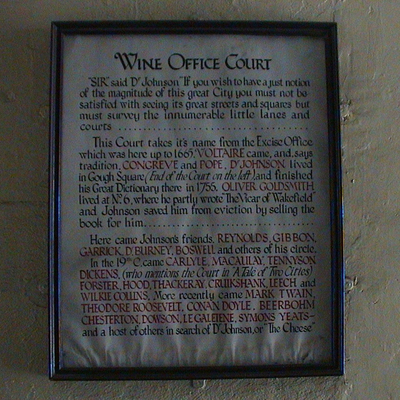
Wine Office Court

The Rhymers' Club is not specifically mentioned on the plaque but Ye Olde Che...

91³Ô¹ÏÍø

Other Subjects

Major Byron F. Caws

Major Byron F. Caws

Believed to have assisted Fowler in his work on the Concise Oxford Dictionary. The Latin on the memorial, 'castigavit et emendavit', translates as “he corrected and improved“, which is quite an ac...

Person, Architecture, Armed Forces, Engineering, Literature

1 memorial
William Combe

William Combe

Writer. Chiefly remembered as the author of 'The Three Tours of Dr Syntax', a comic poem which satirised William Gilpin. 

Person, Literature

1 memorial
Smith, Elder & Co.

Smith, Elder & Co.

Publishers at 65 Cornhill (the picture) until 1868.  Also at 15 Waterloo Place. Their first big success was Jane Eyre by Charlotte Bronte.   They also published: Thackeray, Darwin, Ruskin, Browning...

Group, Commerce, Journalism / Publishing, Literature

1 memorial
Margery Allingham

Margery Allingham

Writer. Born Margery Louise Allingham in Ealing. Initially she studied drama and speech-training to cure a stammer. She turned to writing, and in 1929 published her first successful novel, 'The Cri...

Person, Literature

1 memorial
George Gissing

George Gissing

Goerge Robert Gissing. Novelist, best known for ‘New Grub Street’ about the hack writers who were concentrated in Grub Street, EC2. In 1830 Grub Street was renamed Milton Street; in WW2 it was badl...

Person, Literature, France

3 memorials