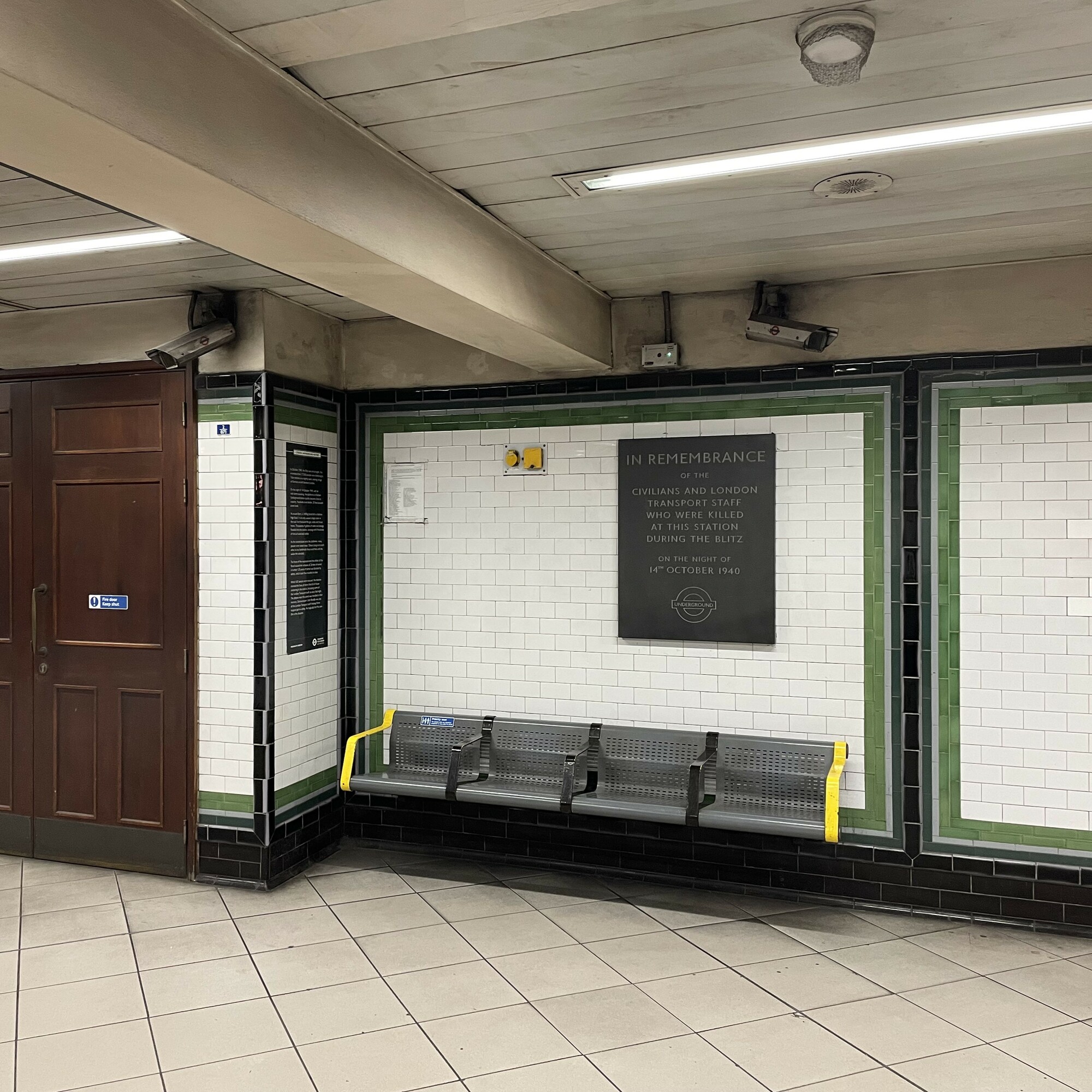

Erection date: 14/10/2010
{Beneath the London Transport logo:}
In remembrance of the civilians and London Transport staff who were killed at this station during the Blitz on the night of 14 October 1940.
Site: Balham Station bombing (4 memorials)
SW12, Balham High Road, Balham Underground Station
The memorial is close to the ticket barrier, train side, on your left as you exit the station.
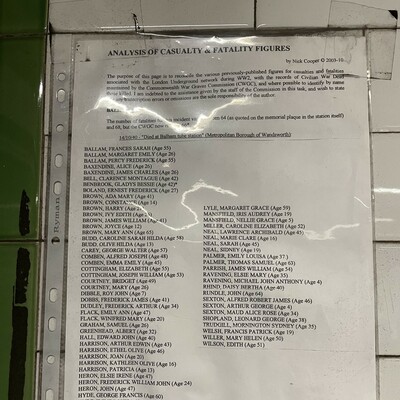
When we last visited in April 2025 there were 3 elements to the memorial: the large black plaque (no 3); a panel describing the horrors in the station that night (in our photo to the left, a welcome and not unusual addition); and an A4 sheet listing the dead (in our photo between the other 2 elements). This last is unusual but, given the prior uncertainly of the number of dead at this event, a very welcome addition.
We have photographs of two memorial plaques at this site which are no longer here:
Plaque 1 incorrectly stated that there were 64 people killed in this incident. The carried the story of how it was discovered that 3 tube workers were not included in that total and TfL was asked to replace plaque 1 with plaque 2, where they wanted the correct total of 67 but the plaque avoided the issue altogether by not specifying a number. We've left both these plaques here for the record, even though they are no longer at the site - reported that plaque 1 is in the LT Museum.
And then in 2014 the Moorgate station plaque was installed, hand carved in the Johnston typeface on Welsh slate. This was considered an appropriate design for memorials of this nature and the decision was taken to use it as the template for the Stratford station plaque and two planned plaques, at Bank station and Sloane Square station, the final two TfL sites that saw significant loss of life in wartime bombings and where no memorial is present. And it was then a short step to the decision to replace the Balham plaque with one in this style. Plaque 2 will be found a home at the LT Museum, probably alongside P1. All this information was provided in 2016 by Mike Ashworth, Design and Heritage Manager of TfL. He also confirmed the reasons for the first replacement: P1 was ‘unofficial’ and got the number of victims wrong; P2 was created to the then official design for heritage signage and prudently gave no number.
This story of the three plaques really brings home the perils of plaque erection. We thank Mike and TfL for their efforts and congratulate them on finding a fittingly dignified design for these plaques.




Comments are provided by Facebook, please ensure you are signed in to see them