
Erection date: 30/6/1975
{Inscribed at the left-hand end of the left-most panel:}
M. L. Watson, Sculpt.
{On the upper plaque:}
Battishill Gardens
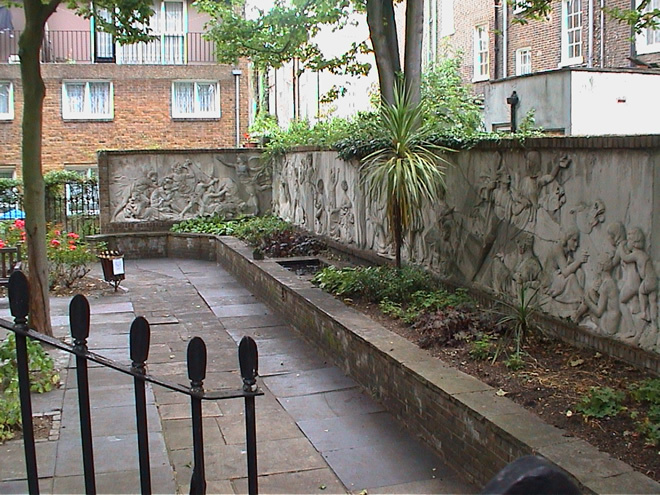
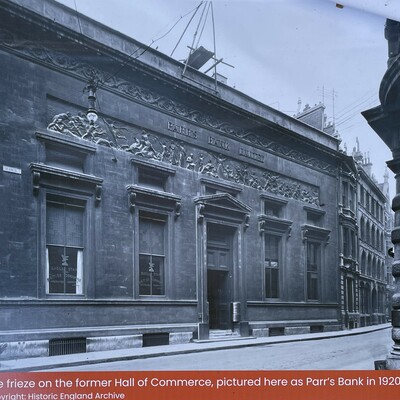
The stone frieze was carved by Musgrave Watson in 1842 and formed part of a Hall of Commerce in Threadneedle Street until it was demolished in 1922. The stonework was salvaged by Sir Albert Richardson and remained in pieces at London University. In 1974 these were given to the Borough Architect who replaced the missing sections to make the frieze a feature in the new Battishill Gardens.
The sculpture is an allegorical composition showing Commerce standing centrally with wings outstretched to welcome all nations. On the left hand side there is a lion and representations of Poetry, Music and Painting; then Enterprise guided by Genius with a group looking towards the Messenger of Peace and Glad Tidings. On the other side of Commerce is Peace and Bearers of Fruits of the Earth; then Navigation guided by Urania and others personifying Geography and Education. To the far right are people of other countries shackled and dejected looking, imploring towards Britannia holding a flag, symbolic of liberty and protection.
Borough Architect - Alfred Head
Project Architect - Helen Stafford
Contractor - W. J. Jerram Ltd
Site Agent - Ronald Nunn
{On the lower plaque:}
These Gardens were opened on 30th June 1975 by Sir John Betjeman, Poet Laureate.
This stone frieze (13 metres long, 2 metres high) was originally unveiled on the Hall of Commerce in 1842. It can be seen in situ on our page for that building.
The frieze was never intended to be viewed at such close quarters and some of the figures are a little comical. Mercury in particular, brandishing a feather, sporting a natty hat and with Pete and Dud’s wispy bits in just the right place, is difficult to take seriously.
Site: Hall of Commerce (1 memorial)
N1, Napier Terrace, Battishill Gardens
From this and this map you can see that Battishill Street used to be named Hardinge Street and was lined both sides with Victorian terraced housing probably just like what remains on the east side. Similar housing used to occupy the east side of Napier Terrace. Maps showing WW2 bomb damage show nothing in these streets and post-WW2 aerial photos show all these houses still in place. But they had gone by 1975 when the gardens were opened.
The very useful indicates that the name change took place 1929-45 and probably 1936-9.
On the day (July 2004) we visited this small paved garden it contained an unusual installation: a single wooden seat with a lectern in front holding a weather-protected page on which was printed "The Drum" an anti-war poem by John Scott (1730 - 83). Both seat and lectern were securely bolted to the ground. (2025: the seat and poem were gone but the lectern remained.)
in the spring of 2025. The stone of the frieze is now much whiter and the carving more pleasing to view. The lettering on the two plaques has been renewed. Also an information panel has been created but when we visited it was lying loose on the raised floor beds and was already beginning to come apart. We transcribed it as follows:
"The Hall of Commerce Frieze
"The stone frieze opposite was made in 1842 by the Victorian sculptor Musgrave Watson (1804-1847). It was originally displayed on the front of the Hall of Commerce in Threadneedle Street, City of London. The Hall later became Parr's Bank before being demolished in 1922, when the frieze was saved and put into storage in University College London.
"In 1975, Battishill Street Gardens was opened as the first purpose-built public garden in Islington since the Second World War. The frieze was unveiled as part of the grand opening by Poet Laureate and champion of Victorian art, Sir John Betjeman.
"The frieze is an allegorical composition showing Commerce standing centrally with wings outstretched to welcome all nations. She also welcomes figures including Poetry, Music and Painting, as well as Geography and Education. The final figure is Britannia, holding a flag. At Britannia's feet are figures in shackles and chains who reach toward her for protection, reflecting the Victorian view of Britain's role in the world. Today, these chained figures remind us of the colonial oppression that took place throughout the British Empire.
"Musgrave Watson was a talented sculptor who died young aged 43. His most prominent work is a bronze relief panel at the base of Nelson's Column in Trafalgar Square, which is seen by millions of people each year.
"In 2025, Islington Council and Heritage of London Trust had the frieze restored. The restoration was done by SSH Conservation. At the same time, new plants were added to promote biodiversity and make Battishill Street Gardens a more welcoming space for residents to enjoy."
At the bottom of this panel is a numbered drawing which acts as a key to the frieze. "L to R: 1. People of the world, 2. Mercury, 3. Enterprise guided by bolts of Genius, 4. Health, 5. Music and Painting, 6. Poetry, 7. Commerce with wings outstretched, 8. Peace, 9. Bearers of natural produce of the world, 10. Navigation guided by Urania, Geography and Education, 11. Shackled figures, 12. Britannia. Illustrated by Meredith Ingham Clark."
explained that when salvaged from the Hall of Commerce's demolition the frieze was put into a courtyard at UCL. When that courtyard was required for a new building Alfred Head, Islington's Architect arranged for its removal to Battishill Gardens. He is quoted: "Two pieces of sculpture were missing, which I remade myself, having attended evening classes. One of the sculptured heads that I made as a replacement was modelled on a colleague, the project architect Helen Stafford, later Helen Watters."



Comments are provided by Facebook, please ensure you are signed in to see them