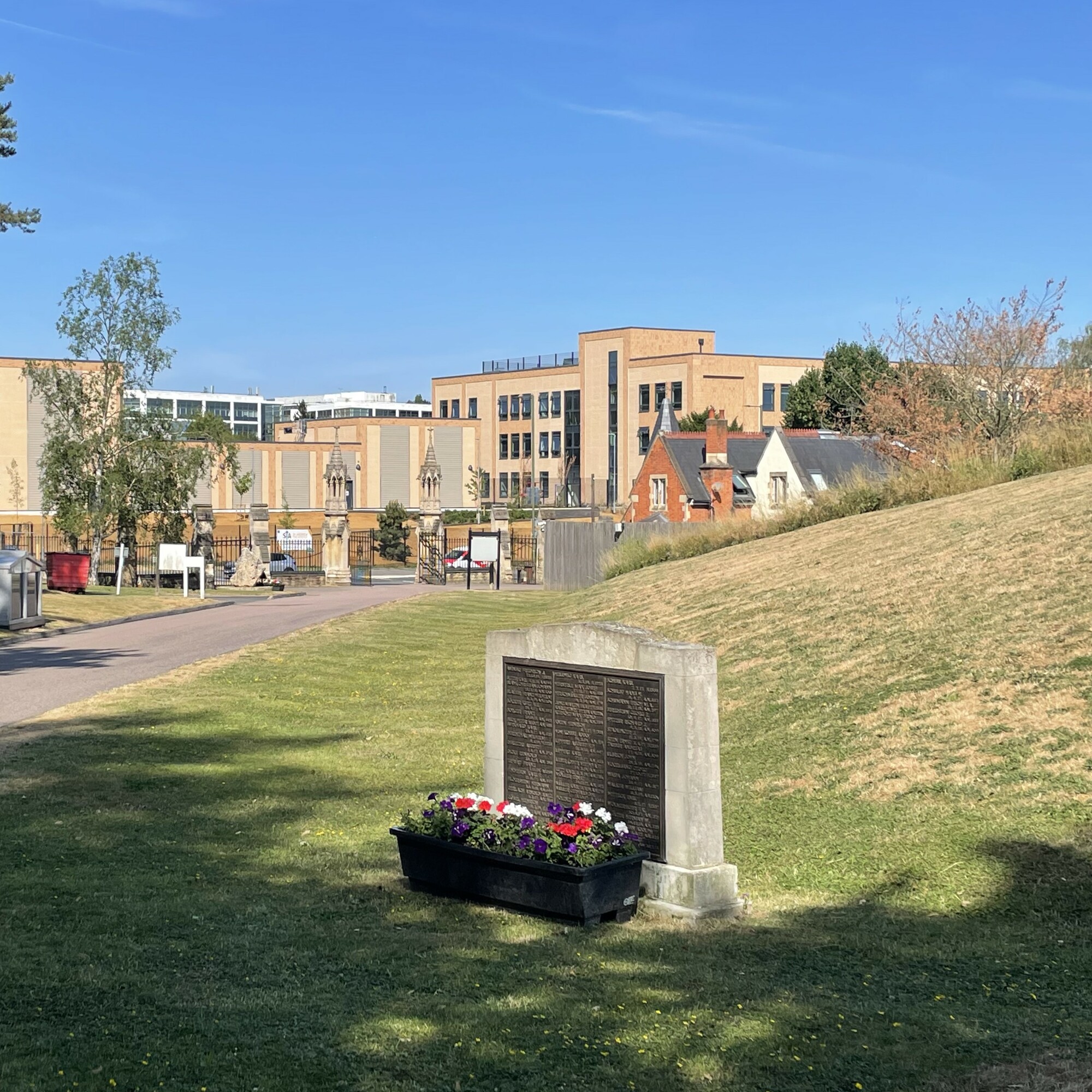
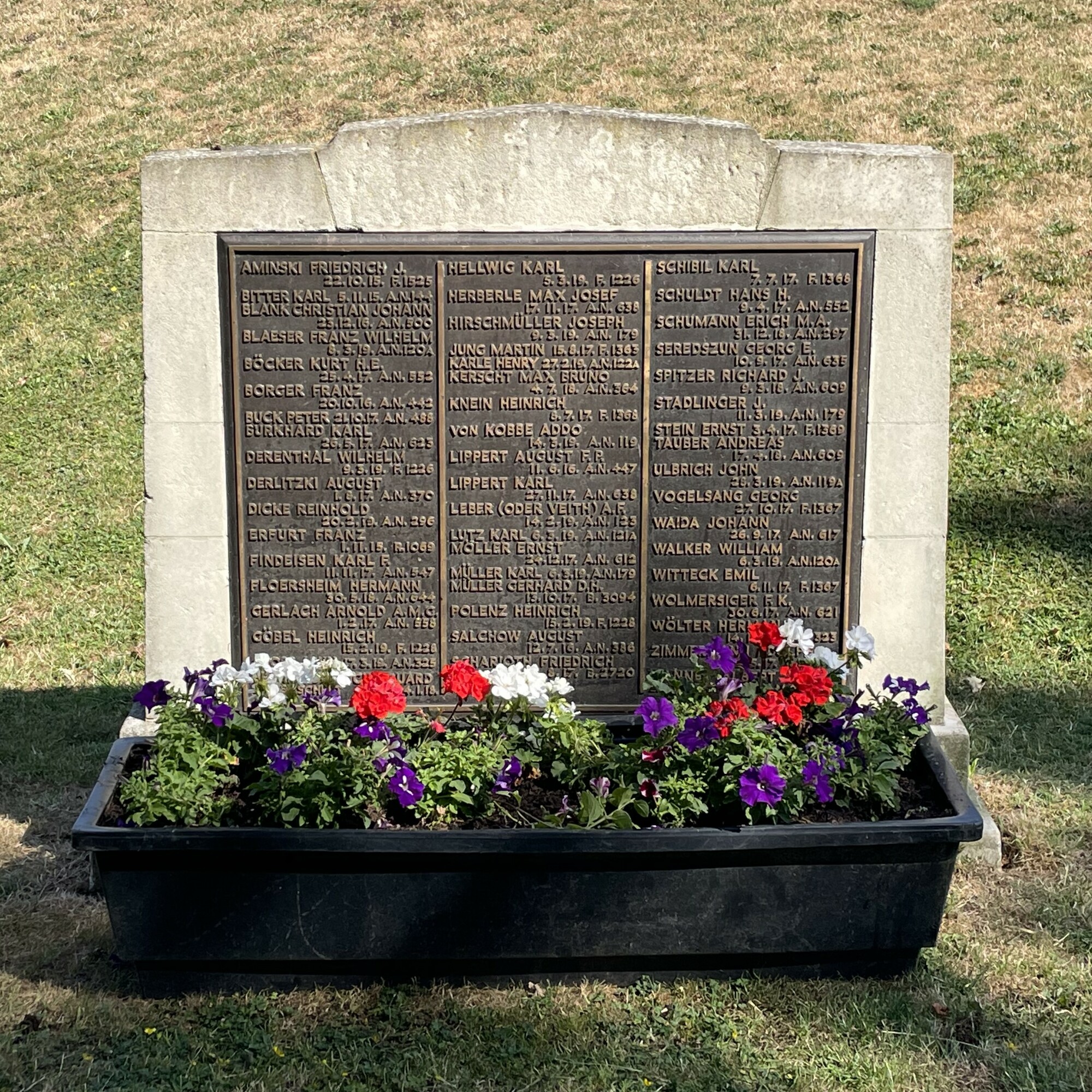
{On the stone base, largely hidden by the flowers in the planter:}
Hier ruhen in gott die genannten 51 deutschen maenner die waehrend des weltkrieges in zivil gefangenschaft gestorben sind.
{This German translates as: Here in God rest the 51 German men who died in civilian captivity during the World War.}
The large panel above has 53 names listed in 3 columns, in alphabetical sequence with the exception of two names, Becker and Wanner.}
Each name is given with the date of death and a code (e.g. AN144 or F1525) which, initially we assumed would refer to a register of internees.
Becker and Wanner have been added at the ends of the first and last columns, with 'eingeaschert' which translates as 'cremated'. Also, instead of the date of death being followed by the code, it is preceded with 'AM'. The '51' on the base would have been correct before these 2 names were added.
As we transcribed this list we noticed that the codes are not unique, e.g. Derenthal amd Hellwig share the code F1226. There are a total of 12 pairs like this, and AN179 is shared between three people. Those sharing a code all have dates of death within a few days of those with whom they share. But so do men with unique codes.
The war memorial in Kensal Green cemetery also has a code against many of the names and there the code indicates the section of the cemetery in which the body is buried. The code being different for the cremations makes us think that the same is true here. If anyone can confirm this theory please contact us.
Site: German war memorial - WW1 (1 memorial)
N11, Brunswick Park Road, New Southgate Cemetery
The Germans buried here were civilians, not members of the armed forces. Germans, and some other nationalities, living in Britain were considered enemy aliens and 17,000 were interned in Alexandra Palace, not all at the same time. One assumes the deaths were of natural causes (and the 1918-20 flu pandemic) although internment may have been a contributing factor. Also, it seems unlikely that burial here was mandatory; it's possible that some, possibly most, of those that died were buried near their homes.
Originally the monument stood on the other side of the path, opposite its current (2016) position. The memorial was restored in 1993.
Sources: , .




Comments are provided by Facebook, please ensure you are signed in to see them