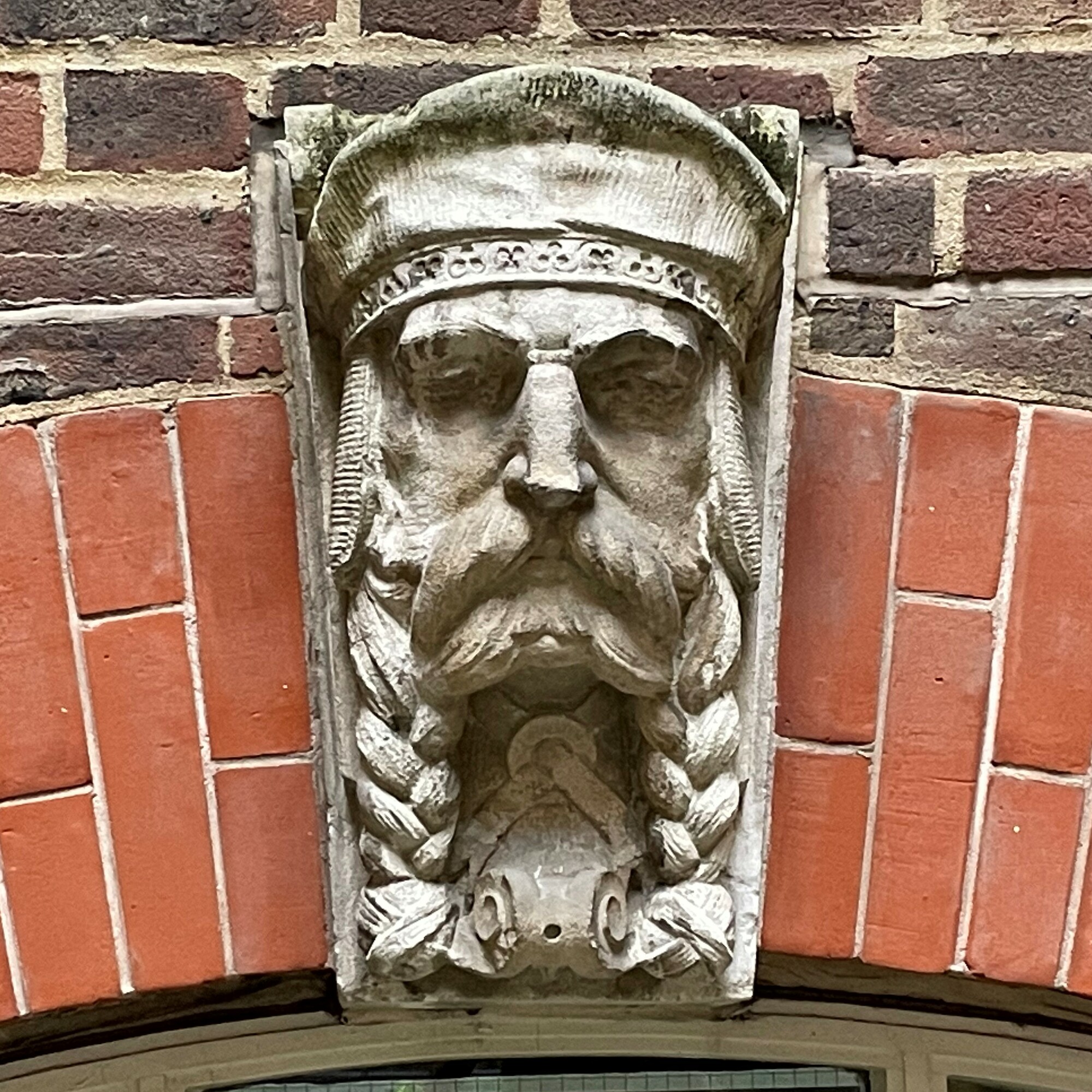
You will see some extraordinary facial hair if you Google with "Viking man plaits moustache cap". It seems that Viking men with plaits like this normally also sport the stereotypical helmet with horns. We cannot find any images with headgear like this. Nor can we find any connection between Vikings and apothecaries.
Site: Pigtails (1 memorial)
EC4, Carter Court
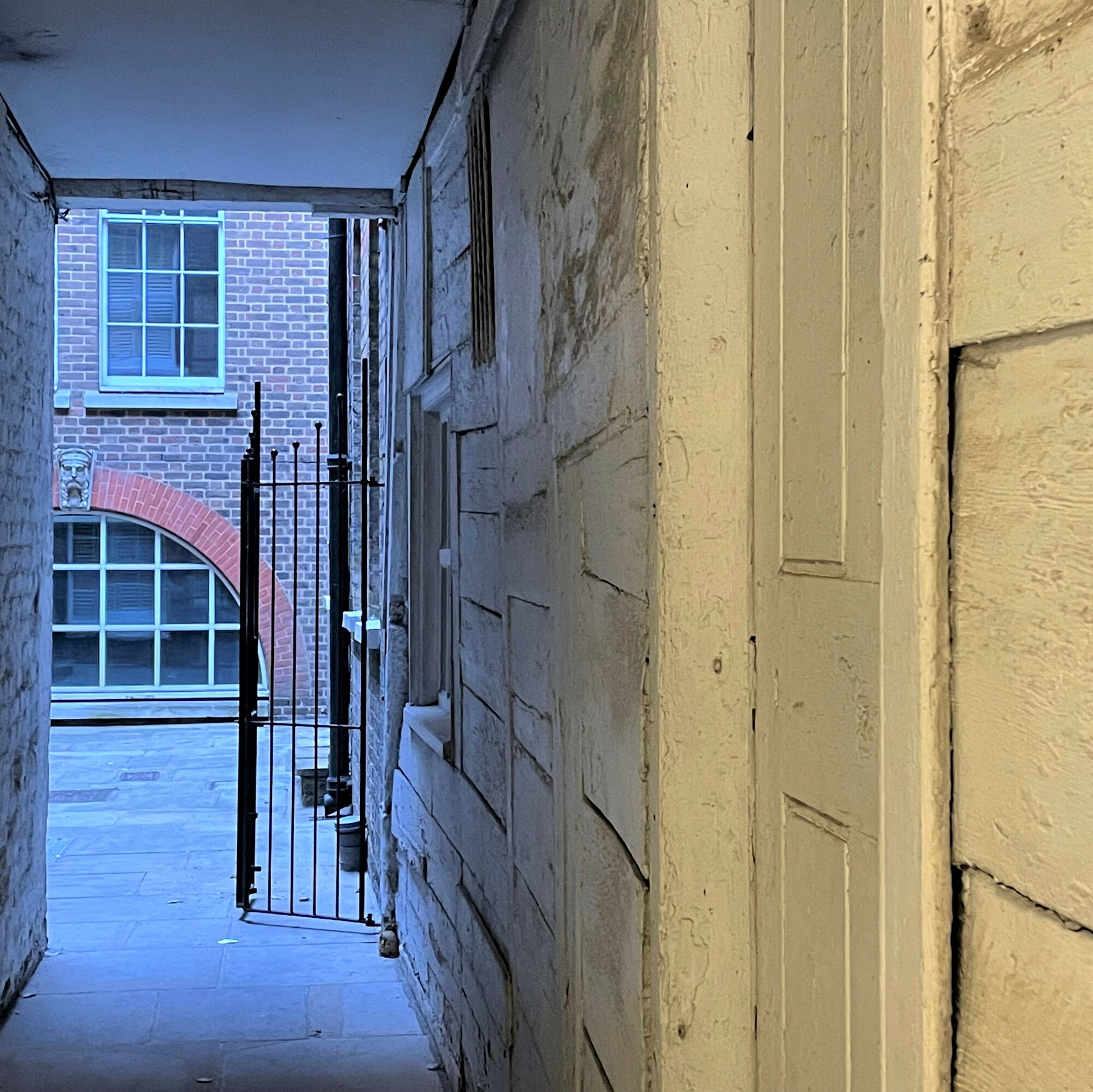
This charming and accomplished keystone is attached to the elevation of a modern building that forms the southern end of Carter Court. It is surely an architectural element retrieved from the building(s) that were demolished to make way for the development.
The southern elevation of Carter Court forms part of the northern wall of the large development that is . It was modernised in 2013 but we can't discover when it was built. To us it looks about 1990ish while the keystone looks late 19th - mid 20th century.
This shows that Carter Court was then known as Fleur de Lis Court, lined with 'D'wellings and 'store houses'. To the west is 'Mill House' and to the south a jumble of buildings (Offices, Halls, Boiler House, Great Laboratory etc.) labelled 'Apothecaries Hall'. We found a floor plan of Cobham House and its footprint includes much of this. Its southern elevation includes two curved bay windows which you can see on .
In 1632 the Apothecaries bought Cobham House to be their first Hall. The insurance map shows that they expanded northwards. In 1911 the Apothecaries sales were falling off so they reviewed their premises. In 1921 the Society’s Laboratory and pharmacy shop closed. The shop and other premised facing onto Water Lane (Black Friars Lane) were let. The site of the Great Laboratory, at the rear of the Hall, was leased by Messrs E. D. Winn who built the office block, Nestor House in 1929, later renamed Mintel House. That 1920s date gels with our sense of the date of the carved keystone. However Mintel House still stands and is anyway too utilitarian to have had decorative features of this type.
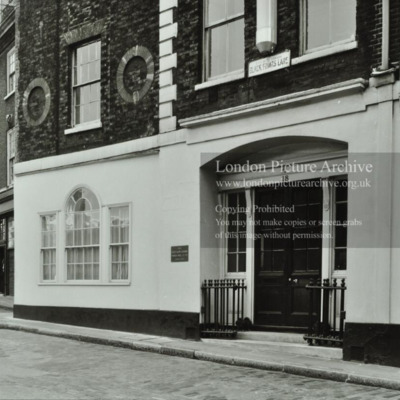
At some point the jumble of buildings north and west of Mintel House was demolished. We think the replacement building, whatever it was, probably boasted this keystone. And then we found the photos of the buildings in Black Friars Lane, at the London Picture Archive - with four keystones.
Another view of the court is available at (who advertise a flat in this court at £375pw).
The entrance to Carter Court is very interesting: the western side is lined with wood boards, rather haphazardly laid out. is referring to this much-patched wooden wall when he states: "A glimpse of pre-Fire {1666 Great Fire of London} lath and plaster work can be found on the wall of Carter Court, an alleyway off Carter Lane."
Black Friars Lane was called Water Lane. the Cobham House curved elevation on Black Friars lane also has a .
Sources include: , , The Buildings and Treasures of the Society of Apothecaries Anniversary Address 1988, .


Comments are provided by Facebook, please ensure you are signed in to see them