
Erection date: 1984
{On a small information board (there in 2012, but probably now lost):}
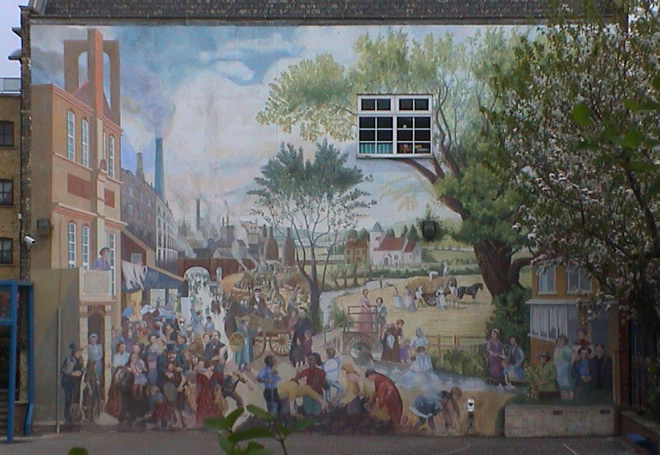
The mural in Polygon Street, NW1 depicts many historical London figures and deliberately uses various artistic influences. The diagram above, and the key below identify the main ones.
1 Elizabeth Garrett Anderson Hospital
2 The Polygon
3 The Brick Kilns
4 Camden Town railway arches and drain
5 Mr Darke's dust heaps (where King's Cross station now stands)
6 Fleet River
7 Old St Pancras Church
8 The Brill
9 St Pancras Housing Association House (Edith Neville Cottages)
10 Elizabeth Garrett Anderson
11 Chimney sweep's boy
12 Charles Dickens and one of his characters, Dolly Varden
13 Father Basil Jellicoe and Mr Tattersall, the dustman's dust cart and Rose Dean, the flower seller
14 Head of Frankenstein
15 Mary Shelley
16 Percy Bysshe Shelley
17 Mary Wollstonecraft
18 William Godwin
19 Dr Monica Shaw
20 Irene Barclay
21 Edith Neville
22 Children from Sir William Collins School, Edith Neville School, St Mary and St Pancras School who worked on the derelict site in front of the mural
History of art references (figures taken from paintings, etc)
23 whole composition and Fleet River section based on Constable's Haywain, et al
24 Figures from Newgate: Committed for Trial by Frank Holl (19th century), Old Man and Casual Ward by Luke Fildes (1870s)
25 Figures from Work by Ford Madox Brown, 1860s
26 Lowryish industrial landscape and figures, 20th century
27 Stubbs's Haymaking, late 18th century
28 Figures based on Camden Town School of painters, c1912 (Sickert, Gore, Gillman, etc)
This mural measures 33 by 44 feet. Its creation and much of its content was inspired by feminism. Each time it has moved, the artist, Karen Gregory, has repainted it. In its third (and so far, final) incarnation she added 3 figures: Claire Tomalin, who lobbied for its rescue; the head teacher of the school; and Sue Child, a teaching assistant.
Site: Somers Town Mural (1 memorial)
NW1, Polygon Road, 43
Seems this mural has moved twice. It was originally commissioned by the GLC and located in the St Mary and St Pancras Church of England Primary School. In 1992, the mural came under threat when its original site was redeveloped for housing. Lobbying from Claire Tomalin and others meant that St Pancras Housing moved it to where we found it, on the end wall of this red-brick building (which we think was the school) with an inconsiderately placed window in the middle. It was moved again in 2007 and now, 2026, is in the same location, overlooking school grounds, but on the end wall of a residential building, no 43.
Sources: .




Comments are provided by Facebook, please ensure you are signed in to see them