91³Ô¹ÏÍø

Monument

Speke

Erection date: 1866

Inscription

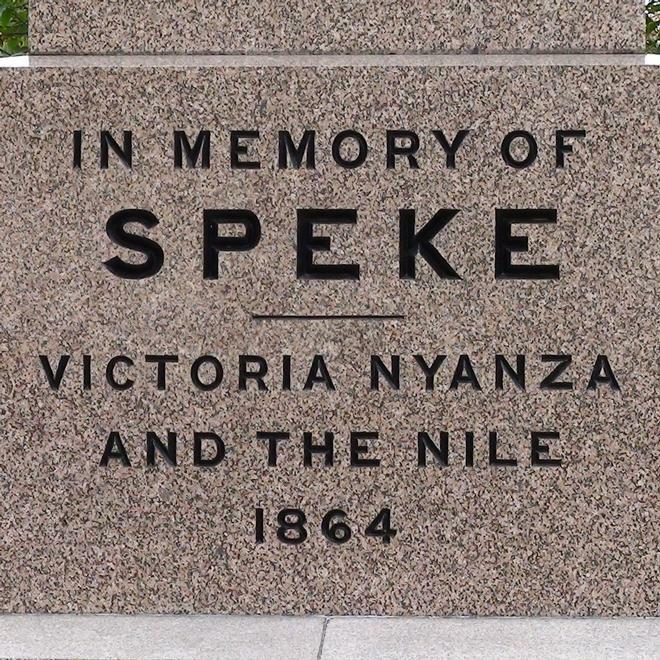
{Carved on the front of the plinth:}
In memory of Speke
Victoria Nyanza and the Nile, 1864.

{On a plaque laid into the ground in front:}
John Hanning Speke - Explorer (1827 - 1864)
Speke was the first European, while on an expedition with Richard Burton to East Africa in 1858, to discover Lake Victoria. On a subsequent journey with James Grant in 1862, he confirmed its northern outlet as the source of the Nile.
This memorial was sponsored by Sir Roderick Murchison, President of the Royal Geographical Society. The cost was met by public subscription.
It was designed by Philip Hardwick, R.A. It is constructed from red granite and was quarried and made in Aberdeen, Scotland.
The memorial was erected in 1866. Speke had died two years earlier in a shooting accident by his own gun immediately before a debate with Burton about the source of the Nile.

This plaque was erected in 1995 by the Friends of Hyde Park and Kensington Gardens.

'Victoria Nyanza' means 'Lake Victoria'.

Site: Speke (1 memorial)

W2, Kensington Gardens

Comments are provided by Facebook, please ensure you are signed in to see them

This section lists the subjects commemorated on the memorial on this page:
Speke

Subjects commemorated i

Richard Francis Burton

Explorer. Born Devon. He and his wife Isabel, have a very unusual tomb at St ...

91³Ô¹ÏÍø

James Augustus Grant

Explorer. born Nairn, Scotland.

91³Ô¹ÏÍø

John Hanning Speke

Explorer. Born Devon. The first European, while on an expedition with Richard...

91³Ô¹ÏÍø

This section lists the subjects who helped to create/erect the memorial on this page:
Speke

Created by i

Philip Charles Hardwick

Architect of St Barts Hospital in 1861. Son of architect Philip Hardwick. We ...

91³Ô¹ÏÍø

Sir Roderick Murchison

Born Tarradale, Ross and Cromarty. Had a successful army career and was set t...

91³Ô¹ÏÍø

Nearby Memorials

Croydon Minster war memorial - cross

Croydon Minster war memorial - cross

CR0, Church Street

"They died that we might live." is a quite common inscription on war memorials and sounds like a quotation but we cannot identify a source.

2 subjects commemorated
Tsunami memorial

Tsunami memorial

SW7, Cromwell Road, Natural History Museum, Darwin Centre garden

120-tonne block of granite, 4.1 metre cube with a corner removed. According to Handy Shipping Guide this was the "biggest transportatio...

157 subjects commemorated, 5 creators
All Hallows, Gospel Oak, War Memorial

All Hallows, Gospel Oak, War Memorial

NW3, Savernake Road, Parish Church of All Hallows

This text is on the north-west face of the stone base to the cross. There was text on at least one other side of the stone but the weath...

1 subject commemorated
Novo Beth Chaim Cemetery - WW2 bomb

Novo Beth Chaim Cemetery - WW2 bomb

E1, Mile End Road, Queen Mary College

A bomb fell here in WW2 destroying a number of graves. This circular walled enclosure and the stone pedestal at the centre commemorate th...

34 subjects commemorated
St Marks, Kennington - WW1 memorial

St Marks, Kennington - WW1 memorial

SW9, Clapham Road, St Marks Church

We can find no source for the quotation "May we ...", though it is also used on memorials in Dorset and Falkirk. There are two columns o...

War dead | WW1
325 subjects commemorated