Site: Belgian war memorial (1 memorial)
NW10, St Mary's Roman Catholic Cemetery
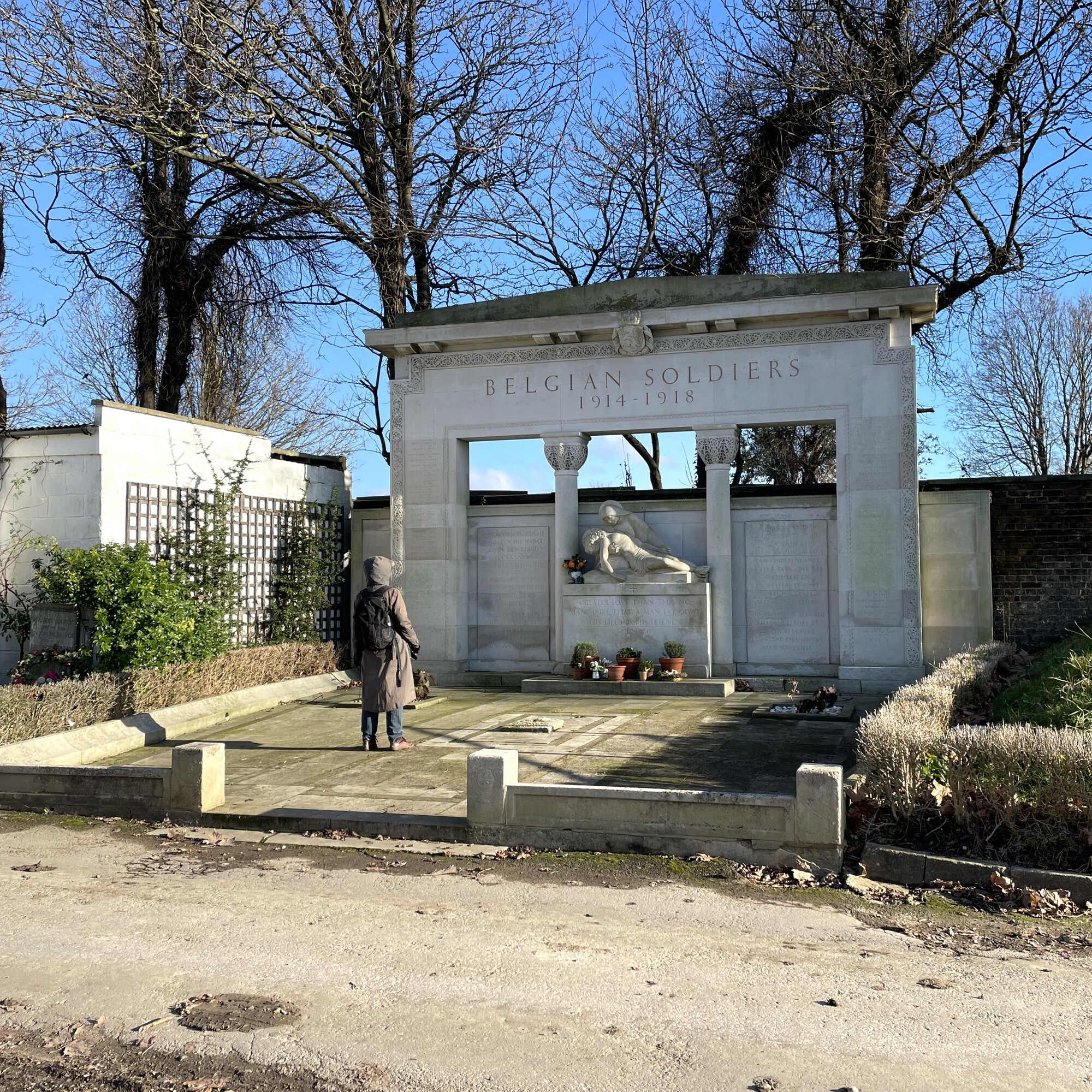
Note that this cemetery is physically separated from Kensal Green Cemetery, its larger neighbour to the east. You cannot pass from one to the other (as we learnt to our cost on a bitterly cold January day). The main route to this memorial is via the entrance at Alma Place, where there is also an entrance to the Kensal Green Cemetery. The only other entrance to St Mary's Cemetery is via a small gate in the north west corner on Scrubbs Lane. Our pin is in the correct location but to find this memorial it may help to know that the white building to the left of our photo is the toilets.
The magnificent gives the story behind this memorial. These Belgians had been treated at St Andrew's Hospital Dollis Hill Lane, NW2. The hospital was created in 1913, financed by a French benefactress. At the beginning of WW1 "Monsignor Maurice Carton de Wiart, the Hospital administrator who was from an illustrious Belgian family, set out with a party of nurses from the Hospital for the village of Hastiere in Belgium. ... Because of its special ability to cope with French-speaking patients, it received wounded soldiers from the French-speaking Belgian army. ... During WW1 ... Carton de Wiart ... acquired a plot of land in St Mary's Cemetery in which to bury the Belgian soldiers who had died at the Hospital. ... In 1923 some 75 bodies were removed ... and then transported to their native towns and villages for burial. The remaining 77 stayed in the cemetery plot."
has a photo of an event at the memorial captioned "Source/Bron: 'Le Patriote Illustré' (1923)" where all the participants are women. This was probably associated with the removal of the 75 bodies that year. In that photo the memorial appears to be complete so one would think there had already been an unveiling ceremony. However, the give the unveiling date as 11 December 1932 and says the ceremony was attended by Baron de Cartier de Marchienne, Ambassador of Belgium, and Bishop Myers, Bishop Auxiliary of Westminster.
Perhaps the removal of the 75 bodies was seen as so significant a change to the memorial that it was decided to re-consecrate it at a new unveiling ceremony. At the very least, either the list of names of the remaining 77 bodies had to be re-inscribed, or newly inscribed, if there had previously been no list.
At the centre top of the monument is the symbol of Belgium: a lion rampant with "Fait l'union la force" (Unity makes strength).
An indication of the close military ties between Britain and Belgium is given every July when .