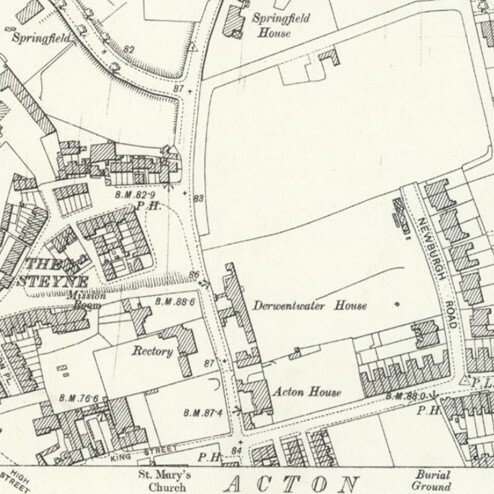
has: "There has been confusion between Acton House {lived in by General Skippon and his wife, c.1650-60} and another residence, called after the last countess of Derwentwater. The countess stayed during her husband's trial {up to 1716/21} at Acton House, in whose grounds Selby {historian Nicholas Selby} built DERWENTWATER HOUSE, possibly in 1804. Selby sold it c.1820 to George Kelly, who owned it in 1842, but in 1859 it was sold to J. B. Nichols. It remained a private house until it became Acton Liberal and Radical Club after 1890. The frontage was reduced for road widening, and the house itself was demolished in 1909."
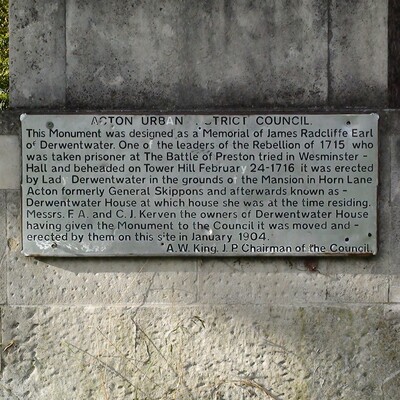
These two houses can be seen on this ((extract shown here), on the east side of Horn Lane, immediately north of Churchfield Road. We think you can also see the obelisk in the rear garden. When erected it would have been in the grounds of Acton House but when, c.1804, a section of grounds was allocated for the construction of a new house it seems the section included the obelisk and perhaps that determined the name of the new house.
In "" by Baker, William King, we found some interesting passages: "Derwentwater House was last in private occupation by Alexander Hubbard Esq., J.P, a director of the Great Western Railway ; but it was afterwards for some years occupied by the Liberal and Radical Club. The frontage, portico and walls were recently taken down for street widening, necessitated by the new tram-way line along Horn Lane; and since, the mansion itself has become a thing of the past. The work of its final demolition took place in November 1909 under the direction of Mr. Kerven of Derwentwater Road."
and
"The Derwentwater House and grounds, ... It is supposed that the house just demolished was built upon the site of a former building occupied for a short time by the Countess of Derwentwater. Nicholas Selby Esq. built the new house in 1804..."
The area was built up over a short period and the 1894 map captures the situation mid-development, just before the west side of Newburgh Road was built up. shows the house numbers clearly: compare that with the 1896 map and the monument looks as if it would have been in the garden of either 6 or 8 Newburgh Road.


Comments are provided by Facebook, please ensure you are signed in to see them