
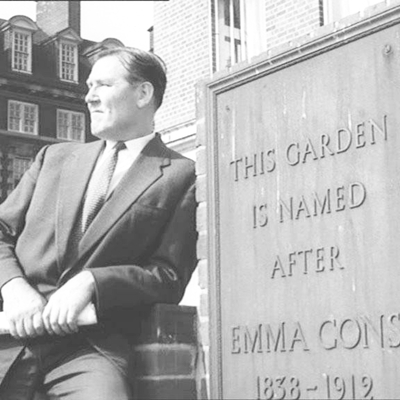
Social reformer and theatre manager. Born London. Knew and was influenced by Octavia Hill, John Ruskin and Henrietta Barnett. Her involvement in the temperance movement led to her taking on the lease of the Royal Victoria Theatre (where alcohol was sold) and reopening it as the Royal Victoria Hall And Coffee Tavern (where it was not), on 27 December 1880. From 1882 the premises were also used for adult education - weekly penny lectures which were very popular. The 'Old Vic' as it was known, struggled financially and in 1884 the philanthropist Samuel Morley provided the funds necessary to keep it going. Other donations from various sources enabled the freehold to be purchased in 1891.
In 1889 she extended the adult education into evening classes and thus founded the first part-time educational institution for working men and women in south London. She named this Morley Memorial College after Samuel Morley who had died in 1886. Cons, together with Caroline Martineau and Lucy Cavendish decided that the college would be staffed entirely by women. This had the desired effect of encouraging women to attend as students.
Some of the first classes were held in rooms under the stage but in the 1920s the college moved to its present site on Westminster Bridge Road.
She established the South London Dwellings Company and through this had built (1884) and herself managed Surrey Lodge Dwellings on the Lambeth Road / Kennington Road corner (home to more than 600 people). Cons lived there with her sister Ellen, in Morton Place. Their niece Lilian Baylis joined them when she returned from South Africa in 1897. Baylis described the relationship between the two sisters as like a marriage with Ellen lovingly supporting Emma. See Baylis's page for more information.
1894 Cons took on the management of the Vic Theatre herself, and continued with that work until she persuaded Baylis to take it on c.1899.
She was the first woman alderman to sit on the LCC, and fought to allow women to serve as local councillors. Cons was also involved in many causes including Women's suffrage and Armenian refugees.
Died at a friend's home in Kent. The W1 plaque's birth year disagrees with the ODNB.
Sources include: 'Lilian Baylis : a biography' by Elizabeth Schafer.


Comments are provided by Facebook, please ensure you are signed in to see them