1698 At Jonathan’s Coffee House John Castaing published a list of currency, stock and commodity prices It included prices for gold, ducats, silver staters and pieces of eight.
1773 A more formal club known as ‘New Jonathan’s’ or ‘The Stock Exchange’ opened in Sweeting’s Alley. The building had a frontage of about 35 feet with a dealing room on the ground floor and a coffee room on the first. The occupation of the new building was the earliest manifestation of a formalised, though not yet regulated, stock exchange.
The says practically nothing about its early purpose-built buildings so we've pieced the story together mainly from information at . The buildings which housed the LSE on its first site have had 4 major phases: 1801, 1854, 1880, 1972.
(1735/1738–1814) designed the first purpose built Stock Exchange, on the east side of Bartholomew Lane. His 1801 building effectively had no street frontage, only a narrow, modest entrance in Capel Court (). The shows that the building had 2 main parts: the entrance hall and the trading floor.
When this become overcrowded (1790–1852) designed a major rebuild which opened in 1854. (1815-97) was architect to the LSE 1855-90. Over the years he supervised various changes and additions.
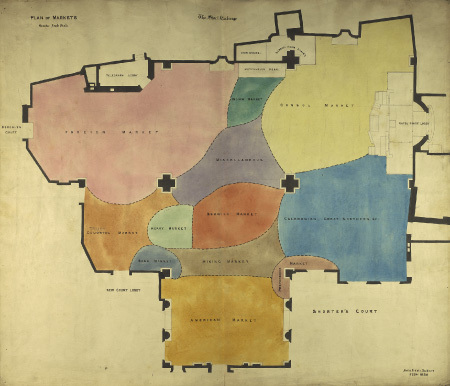
In 1880 Allason's exchange had also become overcrowded. To graphically explore and define the problem, Cole created a very unusual map/plan (Figure 18.1 at ). This has north at the bottom and the Capel Court entrance can be seen at the right. Cole used colour to show how all the space on the (irregularly-shaped) trading floor was being used. Light yellow: consol market (government bonds); pink: foreign market; blue: railway market (labelled ‘Caledonian, Great Northern Ec.); gold: American market.
This plan would also have helped in the design of the rebuild and in making the arrangements for the temporary relocation of the traders to another building for the duration of the renovations.
Cole's massive eastern addition () opened on 9 January 1885. This shows that by that date the Stock Exchange had taken over most of the block. An shows some details of this large complex of buildings. There are now facades on Throgmorton Street and on Old Broad Street. These are offices and were designed to have relatively anonymous street facades. Photos at (LSE on the right) and (LSE on the left).
It seems to be that this was when the entrance to the building was changed to be on Throgmorton Street. The evidence for this is two-fold: it is now often referred to as the Stock Exchange on Throgmorton Street, and, even more telling, a of Throgmorton Street shows (on the extreme left) part of a sign to the entrance of the Stock Exchange.
The insurance plan shows Cole's extension labelled (around the large dome) as ‘New House’. Allason's 'Old House' is labelled beside two domes, one being square (not sure that's allowed). Those two domes together with the large oblong lantern to their immediate north were the roof over the trading floor shown in the Cole's coloured plan. New House seems to have been a separate trading floor. has a number of photos of the trading floor(s) c.1960s. They are not labelled as New or Old House but the architecture is a good guide. But do be careful, mixed in there are also photos of the stock exchanges at Amsterdam, Wall Street, etc.
Note that Threadneedle Walk does not yet exist on the 1896 map. Langton Cole took over from his father and was architect to the LSE from 1890-1925. In 1923 The Exchange received its coat of arms from the College of Arms, and the motto Dictum Meum Pactum – ‘My Word is My Bond’.
It seems that the 1885 extension served the LSE well for over 80 years. Then in 1972 the site was yet again extended, but this time upwards. The 26 storey Stock Exchange Tower has the address 125 Old Broad Street but was built on the site of Cole's extension. The Tower was built by the construction company Trollope & Colls and doesn't seem to have had a named architect.
In 2004 the LSE moved into new headquarters at 10 Paternoster Square, designed by .
The text by Laura Anne Kalba at explores the relationship between the LSE's buildings and the economic environment.
Information from , .


Comments are provided by Facebook, please ensure you are signed in to see them