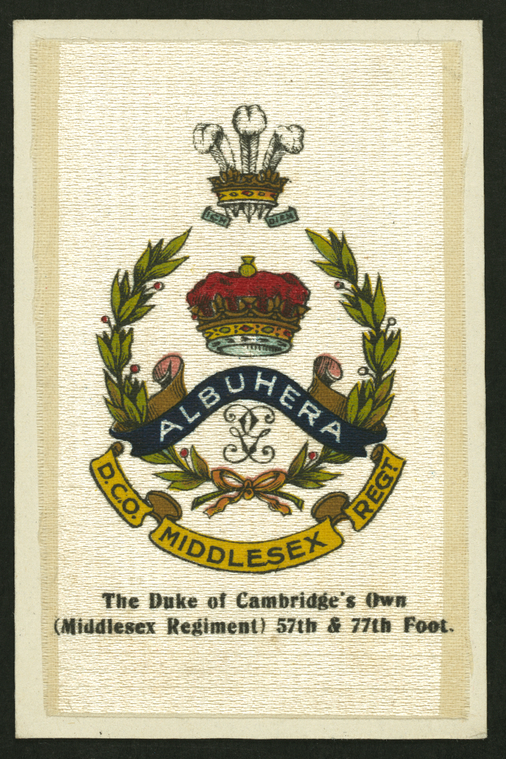
Originally formed as the Duke of Cambridge's Own (Middlesex Regiment) on 1 July 1881, it was created by merging the 57th (West Middlesex) and 77th (East Middlesex) Regiments of Foot. This amalgamation was part of the wider 1881 Childers Army Reforms.
The regiment inherited the designation "Duke of Cambridge's Own" from the 77th Foot, to which regiment it had been awarded in 1876. The regiment was also permitted to bear the coronet and cypher of Prince George, 2nd Duke of Cambridge on its colours and badges. The Duke was colonel-in-chief of the regiment from 1898 to his death in 1904. The regiment had earlier been granted the plumes and motto of the Prince of Wales in 1810 for twenty years service in India.
In 1921, in common with many other regiments, the regimental title was effectively reversed to The Middlesex Regiment (Duke of Cambridge's Own). Its regimental marches were 'Sir Manley Power' and 'Paddy's Resource' (quick), and 'Caledonian' and 'Garb of old Gaul' (slow).
Having seen service in the Second Boer War and the First World War where its number of battalions were greatly expanded, it was reduced in size and following the end of World War Two the regiment was reduced to a single regular battalion (the 1st) in 1948, and two territorial battalions (the 7th and 8th). The 1st Battalion saw action in the Korean War.
In 1966 the four battalions of the Home Counties Brigade were amalgamated to form a 'large regiment' The Queen's Regiment. Accordingly, the 1st Battalion Middlesex Regiment was redesignated as 4th Battalion, The Queen's Regiment (Middlesex), with the other regular battalions being formed by the Queen's Royal Surrey Regiment, Queen's Own Buffs and the Royal Sussex Regiment. In 1968 the 'Middlesex' suffix was dropped and in June 1970 the 4th Battalion was disbanded, with its members distributed among the regiment's three remaining regular battalions.
Credit for this entry to: Andrew Behan.


Comments are provided by Facebook, please ensure you are signed in to see them