explains "The salt tax, which was unknown in England until 1694, was enforced during the greater part of the eighteenth century. The tax was repealed in 1730, but was reimposed at the suggestion of Sir Robert Walpole in 1732." That page is all about Buckingham Street and refers to The Salt Office being, variously, at numbers 12, 14, 19, over the years 1706-88. This is after York House has been demolished and redeveloped into a number of streets including Buckingham Street.

This section lists the memorials where the subject on this page is commemorated:
Salt Office
Commemorated ati
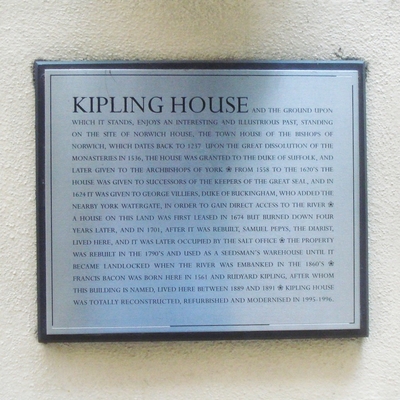
Kipling House
The wording on the plaque could have been clearer. The first half is giving t...
Other Subjects

Anchor / Barclay Perkins Brewery
Thrale.com states that the Anchor name was acquired during Child's ownership, since he supplied the navy with "masts, yards and bowsprits as well as stores and beer." Wikipedia gives the early lif...
3 memorials

One Tun pub - Saffron Hill
The present day pub was rebuilt in 1875.
1 memorial

Admiral Duncan pub bombing
Well known as a gay pub, the Admiral Duncan was the site chosen by Neo-Nazi David Copeland to detonate a nail bomb which killed three people and wounded 70. Copeland, who was also responsible for ...
Event, Commerce, Community / Clubs, Food & Drink, Gender Issues, Terrorism, Tragedy
3 memorials

Angel Inn, near Smithfield Angel Inn
We can't identify this pub.
1 memorial

Ray A. Kroc
Businessman. Born in Oak Park, near Chicago. He joined McDonald's in 1954 and built it into the most successful fast food operation in the world.
1 memorial
Comments are provided by Facebook, please ensure you are signed in to see them