91³Ô¹ÏÍø

Person    | Male  Born 10/11/1697  Died 26/10/1764

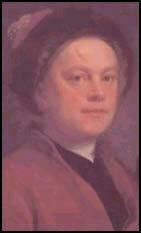
William Hogarth

Categories: Art, Seriously Famous

William Hogarth

Satirical artist and illustrator. Trained as an engraver, he depicted the unseemly behaviour of contemporaries in works like 'The Beggar's Opera' (1728) and 'A Rake's Progress' (1732). Much of his work was pirated and he was instrumental in the passing of the Copyright Act of 1735 which was known at the time as 'Hogarth's Act'. A governor of the Foundling Hospital. Born in Bartholomew Close, Smithfield, he lived in 'Leicester Fields' from 1726 until his death, and he died at home, the east side of Leicester Square. He was buried in Chiswick Parish at St. Nicholas, London, W4.

There are similarities between Hogarth and Dickens: the father being in a debtors' prison; the later successful representation of the individual lives of the poor.

A information board near the Chiswick statue gives: 
In 1749 William Hogarth bought a small house at the edge of the riverside village of Chiswick. He could afford his “little country box” because of the success of his print sales. Over the next 15 years he added new rooms on the south side and a new second floor. Here he entertained family and friends as well as abandoned children from London’s Foundling Hospital, where he was a governor.
After his death William’s family continue to use the Chiswick house. Hogarth was buried at St Nicholas Church, along with his sister, his wife and her mother. His great friend, the actor David Garrick, wrote the epitaph carved on the magnificent tomb.
Since 1904 Hogarth’s House has been a small museum in his memory and the nearby roundabout is named after him. 
London was Hogarth's home for his whole life and its streets and people appear in his pictures. His family was not rich, his father was even imprisoned for debt and William left his apprenticeship with a silver engraver before he finished his training. However, he became a very successful painter and print-maker.
Hogarth was a sharp businessman, selling his prints in the 1730s and '40s by subscription to middle class collectors who paid for them in advance. However, his series of prints telling moral stories were so popular that pirate versions were made by other print-sellers. His campaign for the first copyright law to protect artists' work succeeded in 1735.
After he became financially secure he worked from his town house in Leicester Fields (where the Leicester Square Odeon now stands). His widow, Jane, continued producing and selling his prints from there after his death in 1764.

Comments are provided by Facebook, please ensure you are signed in to see them

This section lists the memorials where the subject on this page is commemorated:
William Hogarth

Commemorated ati

Hogarth - Harrow on the Hill

Looking to connect Hogarth with Harrow we found: c.1800 Crown Street in Harro...

91³Ô¹ÏÍø

Hogarth plaque - gone

William Hogarth, artist, 1697 - 1764, sergeant painter to King George II live...

91³Ô¹ÏÍø

Hogarth statue

Unveiled by Ian Hislop and David Hockney. Funded by donations from individual...

91³Ô¹ÏÍø

Show all 12

Other Subjects

Francis Bacon

Francis Bacon

Born Dublin, of English parents. Died Madrid. 2025: His home in Paris was honoured with a plaque "in courtyard of the studio-cum-apartment near the Place des Vosges where Bacon lived and worked fo...

Person, Art, Ireland, Spain

3 memorials
Alfred William Hunt

Alfred William Hunt

Born Bold Street, Liverpool. Son of the painter William Henry Hunt.  Poet and landscape painter associated with the Pre-Raphaelite Brotherhood. He won the Newdigate Prize in 1851 for his poem ‘Nine...

Person, Art, Benefactor, Poetry

2 memorials
James Cochran, aka Jimmy C

James Cochran, aka Jimmy C

Australian street artist.

Person, Art, Australia

1 memorial
E. H. Shepard

E. H. Shepard

Painter and illustrator, most famously of Winnie the Pooh.   Ernest Howard was born 55 Springfield Road, St John's Wood.  His art school nickname, Kipper, stayed with him for life.  Served in WW1 e...

Person, Art, Children

1 memorial
Donald Rooum

Donald Rooum

Anarchist cartoonist and writer. He has a long association with Freedom Press who have published seven volumes of his Wildcat cartoons. Born Bradford. His main influence for anarchism is Max Stirne...

Person, Art, Politics & Administration

1 memorial

Previously viewed

Wesleys - W1

Wesleys - W1

W1, Wheatley Street

On the low section between the two large buildings in the picture.

3 subjects commemorated, 1 creator
Douglas Belcher VC

Douglas Belcher VC

KT6, Ewell Road

The Belcher plaque is on the stone in the foreground of our photo, and the St Mark's cairn and WW2 memorials behind it.

War served | WW1
2 subjects commemorated, 1 creator
Sir Rowland Hill

Sir Rowland Hill

Initiator of the uniform Penny Post in 1840. Due to him Britain was the first country to use adhesive stamps and thus we do not have to put the name of our country on them. This is analogous to the...

Person, Commerce, Politics & Administration

6 memorials
Penny Post

Penny Post

First established in London in 1680 by William Dockwra and his business partner, Robert Murray, operating only within the City of London, the City of Westminter and Southwark. From 1765 similar ser...

Event, Commerce

6 memorials
Rowland Hill - NW3 - third erection

Rowland Hill - NW3 - third erection

NW3, Rowland Hill Street, Pears Building, Royal Free Hospital

For information about where this plaque has been erected before see Rowland Hill - NW3 - second erection (and stop tittering at the back)...

3 subjects commemorated, 1 creator