91³Ô¹ÏÍø

Group    From 1472 

Worshipful Company of Masons

Categories: Liveries & Guilds

Worshipful Company of Masons

The masons did very well out of the post-fire rebuilding of London. From their : "The focus of our Livery Company is to preserve and encourage the use of natural stone in the built environment. This includes supporting the training of craftsmen as well as the preservation and appreciation of iconic historic stone buildings....

Our Company was formed with the object of regulating the craft of stonemasonry so that standards could be properly maintained and rewarded. The earliest available records of regulation from the Court of Aldermen are dated 1356. In 1472 a Grant of Arms was received under Letters Patent but it was not until 1677 that the Company was formally incorporated by Royal Charter under the seal of King Charles II which gave it authority to control the work of masons in the Cities of London and Westminster and seven miles around. This was a necessary power in order to control the influx of provincial stonemasons assisting in the rebuilding of the capital following the Great Fire in 1666 and to enable the maintenance of strict standards, although governance was never quite as tight again.

Since then members of the Company have been involved in the creation and preservation of the majority of iconic stone buildings and structures across these Cities and nationwide. Joshua and Edward Marshall erected Temple Bar in 1673, the barrier from where trade was officially regulated into the City. Four years later Thomas Strong laid the foundation stone of the new St Paul’s Cathedral and his brother Edward laid the last stone of the building’s lantern in 1708. Both Marshalls and Strongs were Master Masons among a number of other prominent members of the Company who worked on the City’s most beautiful monuments under Sir Christopher Wren. Between 1670 and 1718 at least 8 individuals actively involved in the construction of St Paul’s became Masters of the Masons’ Company."

Comments are provided by Facebook, please ensure you are signed in to see them

This section lists the memorials where the subject on this page is commemorated:
Worshipful Company of Masons

Commemorated ati

Masons Hall

On this site stood the hall of the Worshipful Company of Masons.

91³Ô¹ÏÍø

This section lists the memorials created by the subject on this page:
Worshipful Company of Masons

Creations i

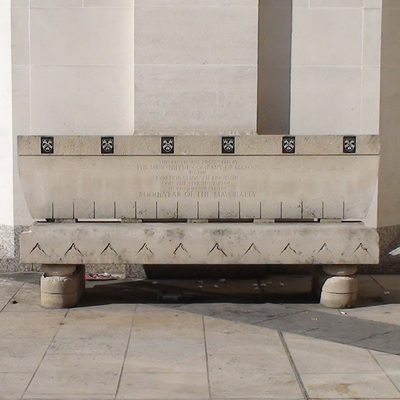
Bench - Mayoralty

Along the front edge of the bench 10 sets of deviders are carved and along th...

91³Ô¹ÏÍø

Other Subjects

Carpenters' Company

Carpenters' Company

The company has been in existence from at least 1271, and received its royal charter in 1477. In common with most other livery companies, it no longer has a role as an association of tradesmen and ...

Group, Liveries & Guilds

1 memorial
Frank Nathaniel Steiner

Frank Nathaniel Steiner

Frank Nathaniel Steiner was Chairman of the City of London Planning & Communications Committee in 1973. 1973-1984 Clerk to the Company of Gardeners.  From The Brotherhood: The Secret World of...

Person, Law, Liveries & Guilds, Politics & Administration

1 memorial
Cordwainers' Hall

Cordwainers' Hall

On their own website the Cordwainers declare that they have had in fact only 5 halls, not the excessive 6 stated on the plaque.  The last was built in 1909 but suffered bomb damage in WW2, which ca...

Building, Liveries & Guilds

1 memorial
Henry James Felton

Henry James Felton

Chairman of Cripplegate Institute in 1894. Henry James Felton is listed as a churchwarden at St Giles Cripplegate in 1885 and as a vestryman in 1887. His son, Charles Page Felton, attended City of...

Person, Industry, Liveries & Guilds, Politics & Administration

1 memorial
Worshipful Company of Plumbers

Worshipful Company of Plumbers

Ordinances 1365, Grant of Arms 1588. The Plumbers' Hall used to stand in Chequer Yard, where Cannon Street station now stands. The first hall was destroyed in the Great Fire of 1666. Rebuilt, it co...

Group, Craft / Design, Liveries & Guilds

4 memorials