Erection date: /11/2019
{One side of the information panel:}
Royal Arsenal History
Next of Kin Memorial Plaque
"He died for Freedom and Honour"
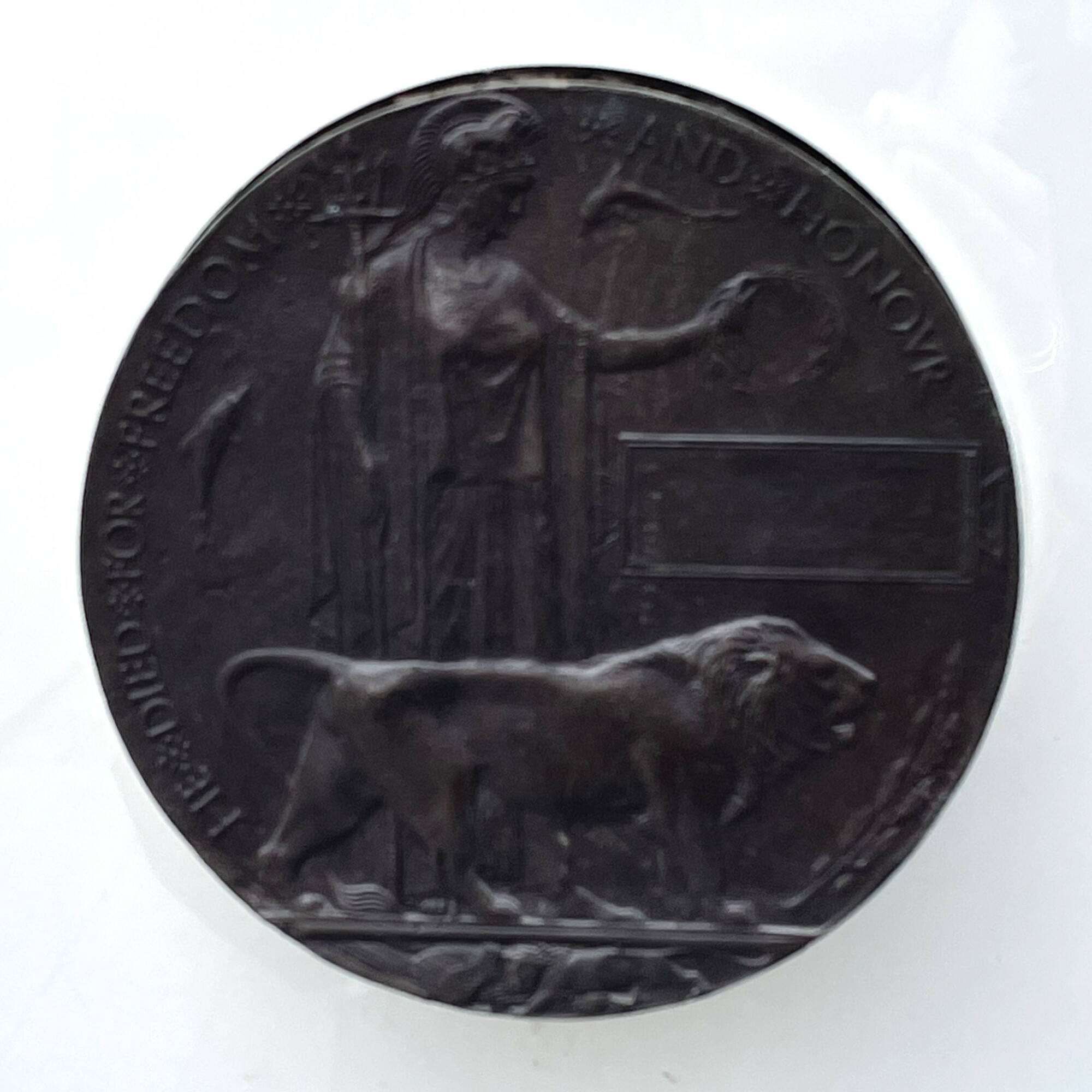
After the First World War, memorial plaques were issued to the next of kin of British and Empire service personnel who died as a direct result of the 1914-18 conflict. The plaques were commissioned by the British Government to give families a physical memorial of their loved ones and honour the sacrifice of men and women who gave their lives. Made of bronze and measuring 4 1⁄2 inches (11cm) in diameter, the plaque was inscribed with the name of the person who died and sent with a message from the King. A memorial scroll was issued separately.
Most of the plaques were made here in Woolwich at the Royal Arsenal, which was the largest munitions factory in Britain during the First World War. More than one million plaques and scrolls were sent to families from the beginning of 1919 and for some years afterwards. But because it was difficult to trace addresses for eligible next of kin after the war, not all British and Empire war dead were honoured in this way. Nevertheless, a lot of plaques survive as family heirlooms, since nearly a million people died in the British Army alone. They are sometimes referred to as the 'Dead Man's Penny', 'Widow's Penny' or 'Death Plaque' due to their resemblance to the old penny coin, which although smaller was also made of bronze.
Design
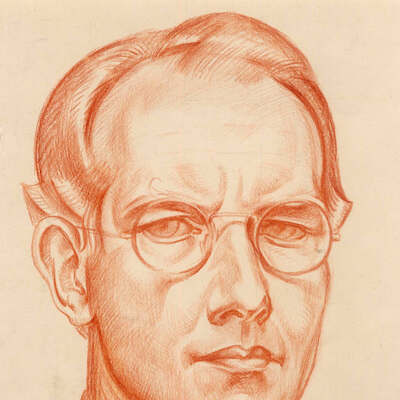
A competition to design the plaque was held before the end of the war and more than 800 entries were received. The winning design was by Edward Carter Preston (1894-1965). You can just see his initials, E CR P, above the foot of the lion on the plaque.
{Replica penny, captioned:}
This is a replica memorial plaque. A little larger than the original but made of the same material, cast bronze. The empty frame below the laurel wreath was designed to contain the name of the man or woman who died in service.
The design features the figure of Britannia holding a laurel wreath in her left hand and a trident in her right. A dolphin is on either side of her, representing Britain's sea power. In front of Britannia, a snarling lion stands with a smaller lion under its feet, biting into a winged creature representing the German Imperial eagle. Below the laurel wreath is the frame designed to contain the name of the commemorated service man or woman. No distinction was made between the sacrifice made by different individuals, so military rank was not included.
The words 'He died for freedom and honour' around the edge of the plaque were specified by the competition committee and had to be included in every design submitted. The winning designer made the first letter 'H' narrower to allow the first word to be adapted to 'She' on plaques honouring female service personnel.
{The other side of the information panel:}
Royal Arsenal History
Next of Kin Memorial Scroll and King's Message
"She died for Freedom and Honour"
The committee responsible for the design of the Next of Kin Memorial Plaque decided it should be accompanied by a memorial scroll, printed on high-quality paper. The choice of words proved difficult and provoked much discussion, but eventually a text was agreed. It was printed from a woodcut produced by artists at the London County Council Central School of Arts and Crafts. The decorative calligraphic script was placed underneath the Royal Crest.
At the bottom of each scroll, the rank, name and regiment of the individual commemorated on the plaque was individually handwritten, also in calligraphic script.
A letter from King George V, which included a copy of his signature, was sent in the same package as the plaque. Scrolls were sent separately inside a cardboard tube. The plaque and scrolls often arrived some considerable time apart. Not surprisingly, far fewer of the scrolls and letters have survived, because of the more delicate nature of the paper.
Production
Production of the plaques did not start until December 1918 due to a scarcity of materials. Memorial scrolls began to be made in January 1919. At first, they were manufactured at the Government's Memorial Plaque Factory in Acton in west London. Production then moved in 1920 to the Royal Arsenal in Woolwich.
{Replicas of the scroll and of the letter from King George V.}
Plaques made in Woolwich have the letters WA, for Woolwich Arsenal, combined as one letter inside a circle, stamped on the back of the plaque. More than one million plaques and scrolls were eventually produced and issued to next of kin, to honour the men and women who died as a direct result of the war.
Woolwich station
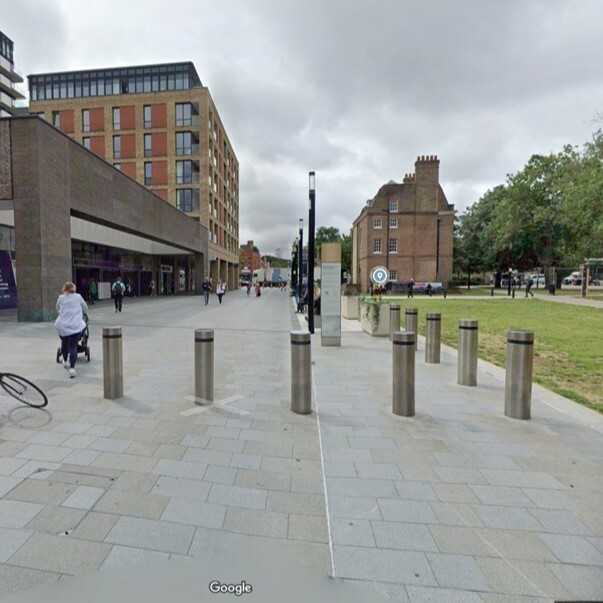
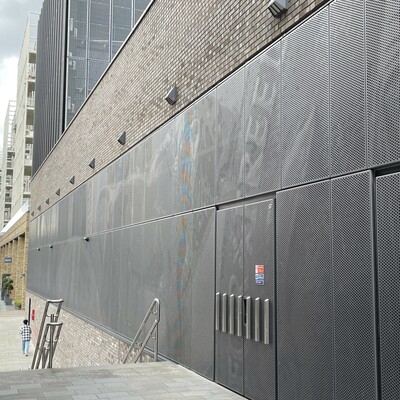
Woolwich station on the Elizabeth line is situated at the heart of the Royal Arsenal, a site steeped in military history that can be traced back to the late 17th century. At the time of the First World War, the Royal Arsenal employed around 80,000 people, largely in the manufacture of armaments and ammunition. To link the station with its remarkable history, a contemporary representation of the Next of Kin memorial plaque has been used as a design motif throughout the station. It can be seen on the west and east external facades in the perforated aluminium cladding as well as above the main entrance gates on printed glass panels.
Site: Dead man's penny (2 memorials)
SW18, Crossrail Path, Woolwich Crossrail station
The Oeuvre Nationale le Souvenir Belge is possibly the Belgian equivalent of the British Dead man's penny.




Comments are provided by Facebook, please ensure you are signed in to see them