{Upper plaque, top section:}
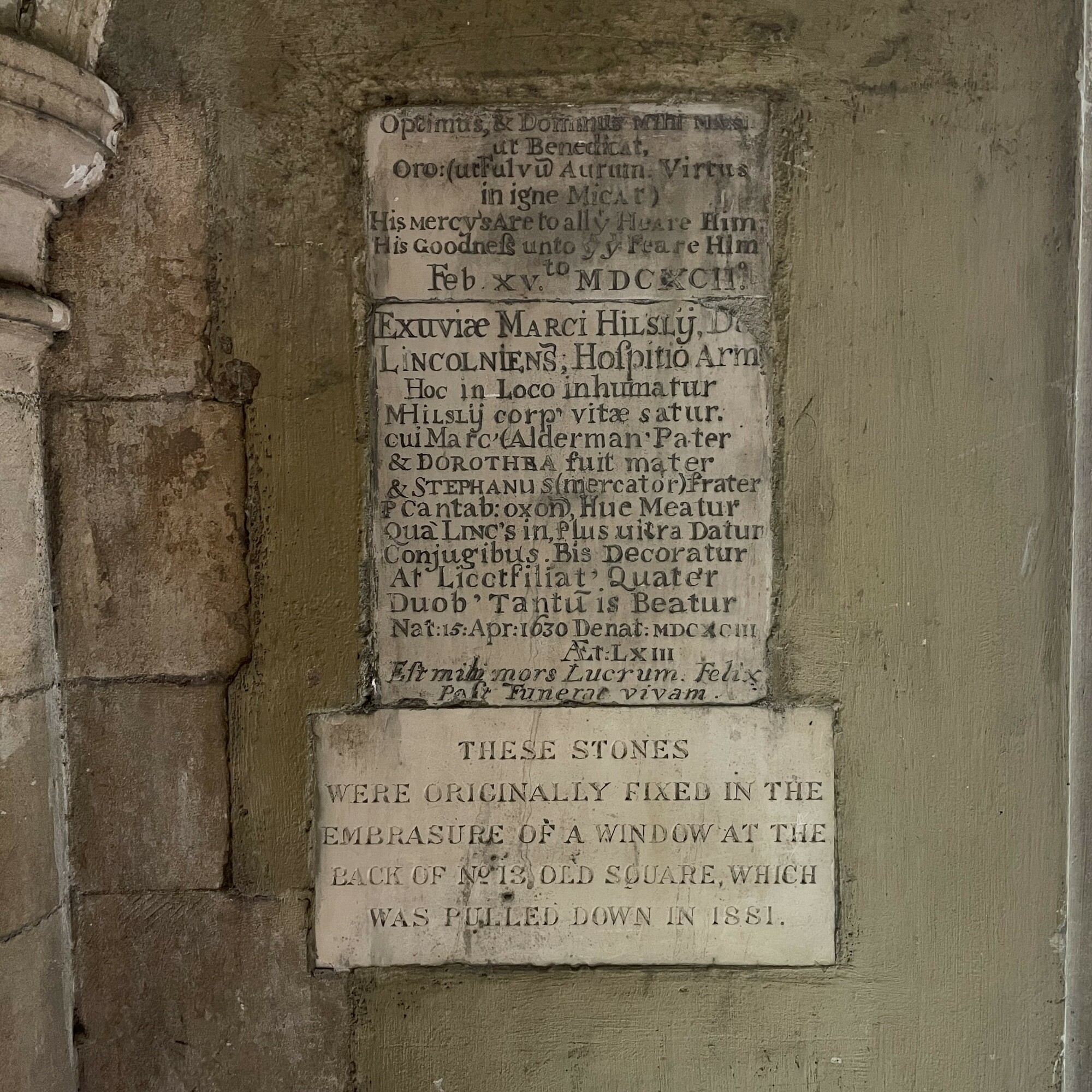
Optimus, & Dominus Mihi Maxi[mus] ut Benedicat,
Oro: (utFulvu[m] Aurum. Virtus in igne Micat)
His Mercy’s Are to all yt Heare Him,
His Goodness unto y? y? Feare Him
Feb XVto MDCXCIIo
Translation / Modern English version
I pray that the best and greatest God bless me
(as Virtue sparkles in the fire like yellow gold).
His mercies are to all that hear him.
His goodness unto those that fear him.
15 Feb 1692
{Upper plaque, lower section:}
Exuviae MARCI HILSLij, De LINCOLNIENS?, Hospitio Arm?
Hoc in Loco inhumatur MHILSLij corp’ vitae satur.
cui Marc’ (Alderman’ Pater & DOROTHEA fuit mater
& STEPHANUS (mercator) frater P Cantab: oxon?,
Huc Meatur Qua LINC’S in, Plus ui[l?]tra Datur Conjugibus.
Bis Decoratur At Licetfiliat’. Quater Duob’ Tantu? is Beatur
Nat:15:Apr:1630 De nat: MDCXCIII AEt : LXIII
Est mihi mors Lucrum. Felix Post Funera? vivam.
Translation
In memory of Mark Hilsly (armiger) of Lincolns Inn
In this place is buried the full mortal remains of M Hilsly whose father was Mark (an alderman) and mother was Dorothy and brother was Stephen (a merchant), ? of Cambridge and Oxford.
He travelled here from far away Lincolnshire to be married.
He was rewarded {ie married?} twice and, although granted four children, he is now blessed with only two.
Born 15 Apr 1630, Died {?} 1693, Age 63
For me, death is gain. After burial, I will live in happiness.
{Lower plaque:}
These stones were originally fixed in the embrasure of a window at the back of No. 13 Old Square, which was pulled down in 1881.
We are immensely grateful to our Latin consultant, David Hopkins, for his work on these stones: he transcribed and translated them, commenting: "The language is actually very tricky to 'decode' because everything is abbreviated and it's written in a poetic style, but here is my best guess." David also provided some useful notes, as follows:
The three y’s in the top section are actually the Old English letter thorn, which represented “th”.
It is puzzling to see “De nat” (from birth), rather than “Ob(iit)” to indicate his year of death.
The last line in the lower section is a biblical reference from Philippians 1:21 in the Latin Vulgate: "Mihi enim vivere Christus est et mori lucrum." ("For to me, to live is Christ, and to die is gain.")
To which we add:
An armiger is a person entitled to heraldic arms.
"the back of no. 13 Old Square" suggests the stones were on an east-facing wall.
We think the top section of the upper plaque did not come from Hilsly's grave. Reasons: it looks physically separate from the lower section; its text contains no reference to Hilsly; it is dated 1692, the year before Hilsly died (which rather clinches it).
Site: Mark Hilsly burial stone (1 memorial)
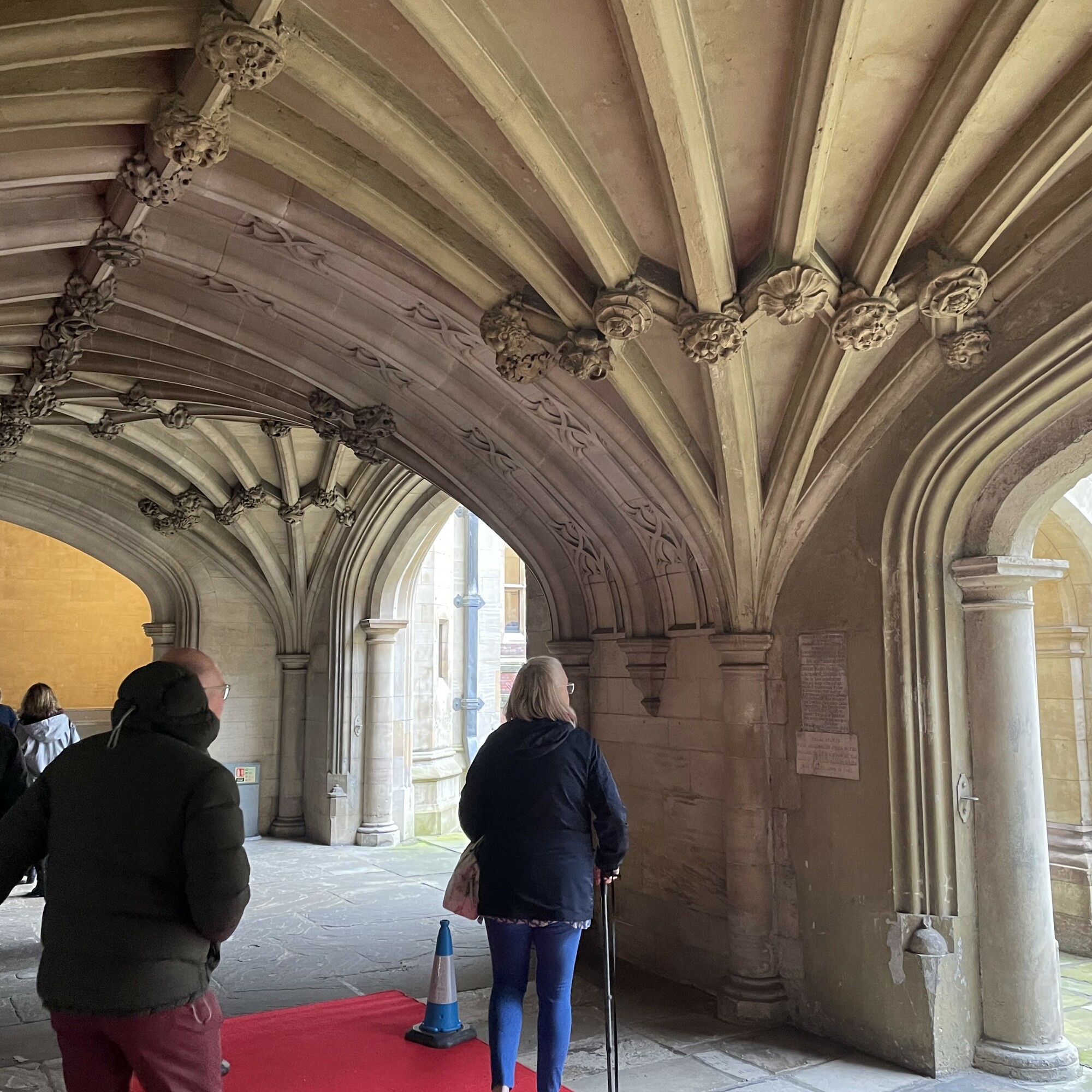
WC2, Old Square, Chapel undercroft
These stone are inlaid into the north wall of the undercroft.



Comments are provided by Facebook, please ensure you are signed in to see them