Site: Church House of St Saviour's Church (2 memorials)
W5, The Grove, St Saviour's Church House
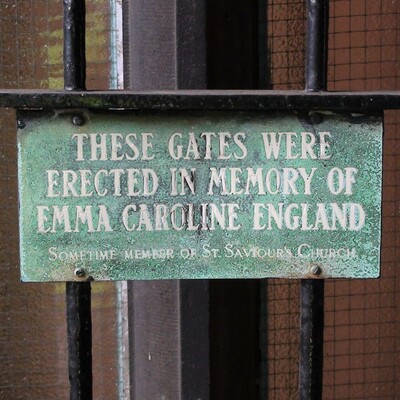
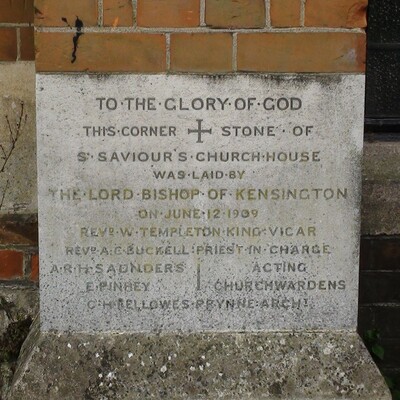
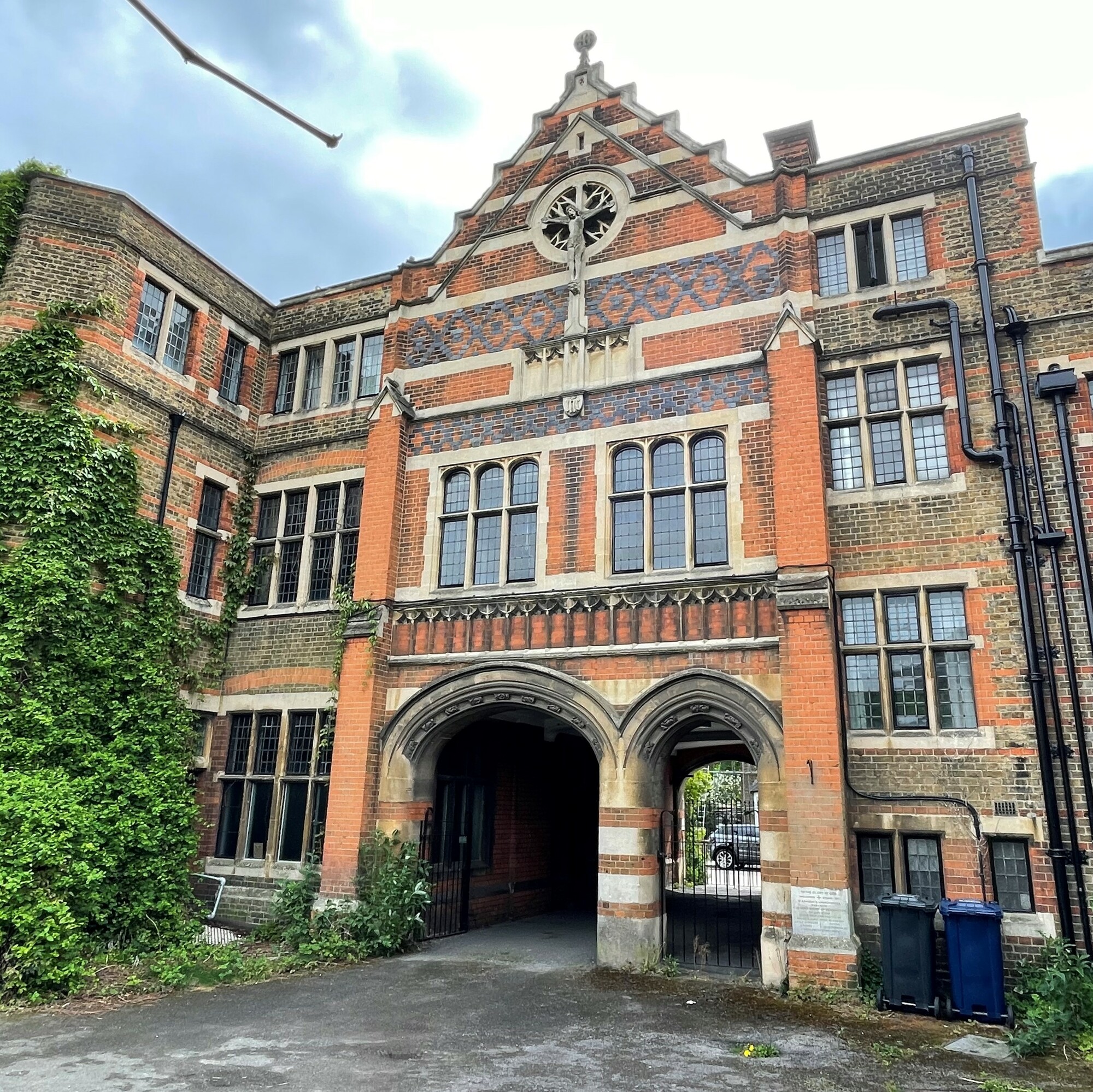
In our photo, which shows the rear of the building, the foundation stone can be seen low down, to the right of the smaller arch. The gates being open means that the England plaque can just be seen in our photo, under and on the left of the larger arch. In this open space, but behind the camera, there is a large stone crucifix. On that page we boast about how we spotted the church in a 1952 film.
This ornate building was the Church House of, and gatehouse to, the Church of St Saviour. The front is even more ornate, with stone panels inscribed "St Saviour's Church" over the large arch and "Church House" over the smaller arch. The building to the west (to the right of, but outside, our photo), in a similar style has stone panels: "St Saviour's" "Infant" "School" and what looks like the original school bell is still attached to the front wall.
The Church of St Saviour was built in The Grove as the church of a new parish carved out of Christ Church (Ealing Broadway). Designed by George H. Fellowes Prynne and built 1897-99, the church was set back from the street line on a large plot of land.
On that street line this Church House was then built. Also designed by Prynne, it was completed in June 1909 and doubled as a gatehouse to the Church. The development consisted of: the Clergy House (to the west) providing accommodation for a vicar and the parish clergy (4 more men); a servants' (3 servants) wing (at the north west); a caretaker's flat and a men's social club (to the east) with their own stairs.
In 1940 the church was badly damaged by WW2 incendiary bombs but the Clergy House survived. In 1951 it was decided not to re-build the Church of St Saviour. Instead, the congregation united with that of Christ Church Ealing Broadway, which, to reflect the merger, became the Church of Christ the Saviour. The Clergy House became the Parsonage House.
The church and the Church House can be seen in this (lower right) and this (middle of lower half).
Sources include: , , ,
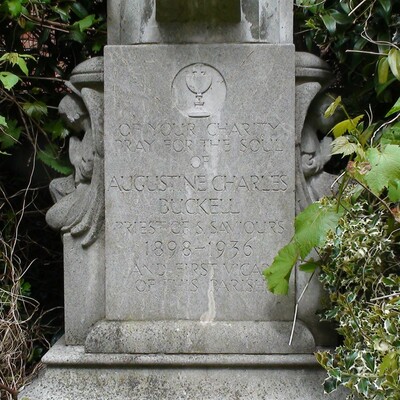
Researching these memorials we came across an interesting with a tangential connection to this church. The victim, Florence Nightingale Shore, god-daughter to Florence Nightingale, is considered to be the richest person ever killed on a British train. On 12 January 1920, travelling third class (surprisingly) between Victoria and Hastings she was discovered at Polegate station, murdered in her carriage. Dr Bernard Spilsbury carried out the post mortem. Items of value were missing so robbery was assumed the motive but the murderer was never found. The high-profile funeral was held at St Saviour’s Church on 20 January. The body was draped in a union flag and three candles were lit on each side. The Reverend A. C. Buckell conducted the service.