91³Ô¹ÏÍø

Place    From 1768  To 1935

Adelphi Terrace

Categories: Architecture

Adelphi Terrace

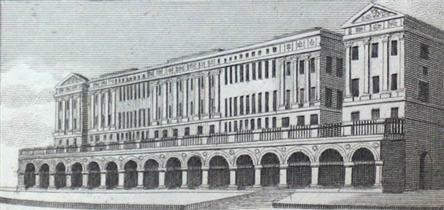
The Adam brothers built a very large development including a run of houses with a terrace that overlooked the river, which was much closer before the Embankment was built. It was this terrace that caused the word "terrace" to take on the meaning of a row of houses. Torn down in 1935 and replaced with the art deco New Adelphi building. It was the demolition of the Adelphi that was, at least partially, responsible for the creation of the Georgian Society in 1937.

is a very useful page with excellent images.

While thinking of how London has changed the English language, in the field of architecture at least, let's examine "Mews". From the French, it used to mean a place where hawks (kept for hunting) were confined during their moulting seasons. From 1377 the King's Mews was at Charing Cross, about where Trafalgar Square now is. In 1537 Henry VIII had it converted to be the royal stables. And hence Mews became the term for all service streets in London built as stables, converted into garages and then converted into rather chic homes for fashionable Londoners, such as .

The image on this page shows a front elevation very different from that on our Garrick page. In 1872 the Victorians obliterated the Adams' neoclassical façades, adding heavy decorative features, around the windows and the bulky central attic pediment. The resultant houses would have been unrecognisable to their architects.

Drawings at the Rise and Fall make it clear that the houses at the two ends of the Terrace were detached from the main body of 10 houses.  No.11, the detached house at the eastern end, survived not just demolition in the '30s but also the attentions of the Victorians. Google Maps does not provide a good view of it but has a photo, from which one can imagine how impressive the whole Terrace must have been during its first 100 years.

For more information see ''. There is also from Hansard, a splendid speech made by , 16 March 1933. gives all the occupants.

Comments are provided by Facebook, please ensure you are signed in to see them

This section lists the memorials where the subject on this page is commemorated:
Adelphi Terrace

Commemorated ati

Adam, Hood, Galsworthy, Barrie, etc.

Robert Adam, Thomas Hood, John Galsworthy, Sir James Barrie and other eminent...

91³Ô¹ÏÍø

Garrick plaque - gone

Garrick died in this house. Erected April-May 1876.

91³Ô¹ÏÍø

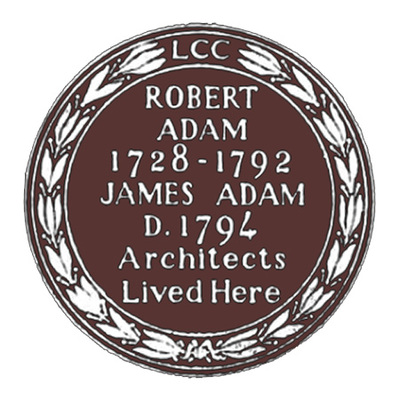
Robert and James Adam - WC2

This plaque was lost when No.4 and all but one of the other houses in the Ter...

91³Ô¹ÏÍø

The Adelphi

The inscription was created by Sharpington. The photo on his page (27 Novembe...

91³Ô¹ÏÍø

Other Subjects

Burnet, Tait and Lorne

Burnet, Tait and Lorne

Architects. The practice comprised John James Burnet, Thomas Smith Tait and Francis Lorne. Their works include the King Edward VII galleries at the British Museum.

Group, Architecture, Scotland

1 memorial
Society for the Protection of Ancient Buildings

Society for the Protection of Ancient Buildings

Founded by William Morris, Philip Webb and others associated with the Pre-Raphaelites to counteract the highly destructive 'restoration' of medieval buildings being practised by many Victorian arch...

Group, Architecture, Community / Clubs, History

1 memorial
Edward Monson, Jnr

Edward Monson, Jnr

This Edward Monson would have been 40 when St Albans was built. His father (Edward Monson) was a civil engineer. and junior's architect son, Edward Charles Philip Monson would have been 15. So we a...

Person, Architecture

1 memorial
Edwin Clare

Edwin Clare

Architect active in 1871. Probably the same Edwin Clare who worked on St. Silas' Penton Street and St Andrew's Croydon, both while based at 104 Guildford Street, and St Saviour's Forest Gate.

Person, Architecture

1 memorial
John Nash

John Nash

Born in London. Notable works: Regent Street, Royal Opera Arcade and the Royal Pavilion, Brighton. Much of his work was for the Prince Regent but we've heard that Mrs Nash gave birth to an illegiti...

Person, Architecture, Seriously Famous

7 memorials