c.1485 the priory built , a manor house near the River Lea, still standing as the oldest brick building in London.
1532 Holy Trinity Priory was the first to be dissolved by Henry VIII in what we know as the dissolution of the monasteries.
2025: Here below is some text from a new information panel installed in Mitre Square:
"Amidst the mainly timber and brick buildings on surrounding streets, Holy Trinity Priory would have been a distinctive complex of stone buildings, with much fine glazing and ornamentation. It abutted the landmarks of the City wall and Aldgate. Established by 1108, from the outset the Priory seems to have been especially popular with the elite, with burials on the site displaying characteristics of high-status individuals. Two of King Stephen's children were buried in chapels either side of the alter in the priory church in the years shortly before 1147, and London's first mayor, Henry FitzAilwin, was also buried within the Priory. Much rebuilding occurred from the late 12th century until about 1350, a further indication of the Priory's wealth.
"Dissolution and subsequent fragmentation
During the English reformation, Holy Trinity Priory was the first monastic house to be dissolved by Henry VIII, in 1532, three years before the general Dissolution. The Priory and its site passed to Thomas Audley, who as Speaker and then as Lord Chancellor was a key figure in the break with the Catholic church. Chancellor Audley adapted the Priory buildings in to a house, often used as an informal gaol for suspects accused of treason. After his death here in 1544 the Priory site became the property of the Duke of Norfolk {the Duke having married Audley's only surviving child, Margaret}; the name of nearby Duke's Place commemorates this fact.
"The Dissolution removed the then familiar sight of monks, friars and nuns from the City streets, silenced their bells and choirs, and undid their charitable and medical works causing profound social and religious change. Following its sale to the City Corporation in 1592, the Priory buildings and old Tudor mansions were fragmented into smaller houses and industrial premises. A Priory chapel became the parish church of St Katharine Cree on Leadenhall Street, rebuilt in its present form in 1631. The old Priory ruins gradually became submerged by new buildings and development.
"Only streets and street names now show what lies beneath your feet: by the early 19th century the nave of the old Priory church had become Mitre Street, while the layout of the old cloister was preserved as Mitre Square."
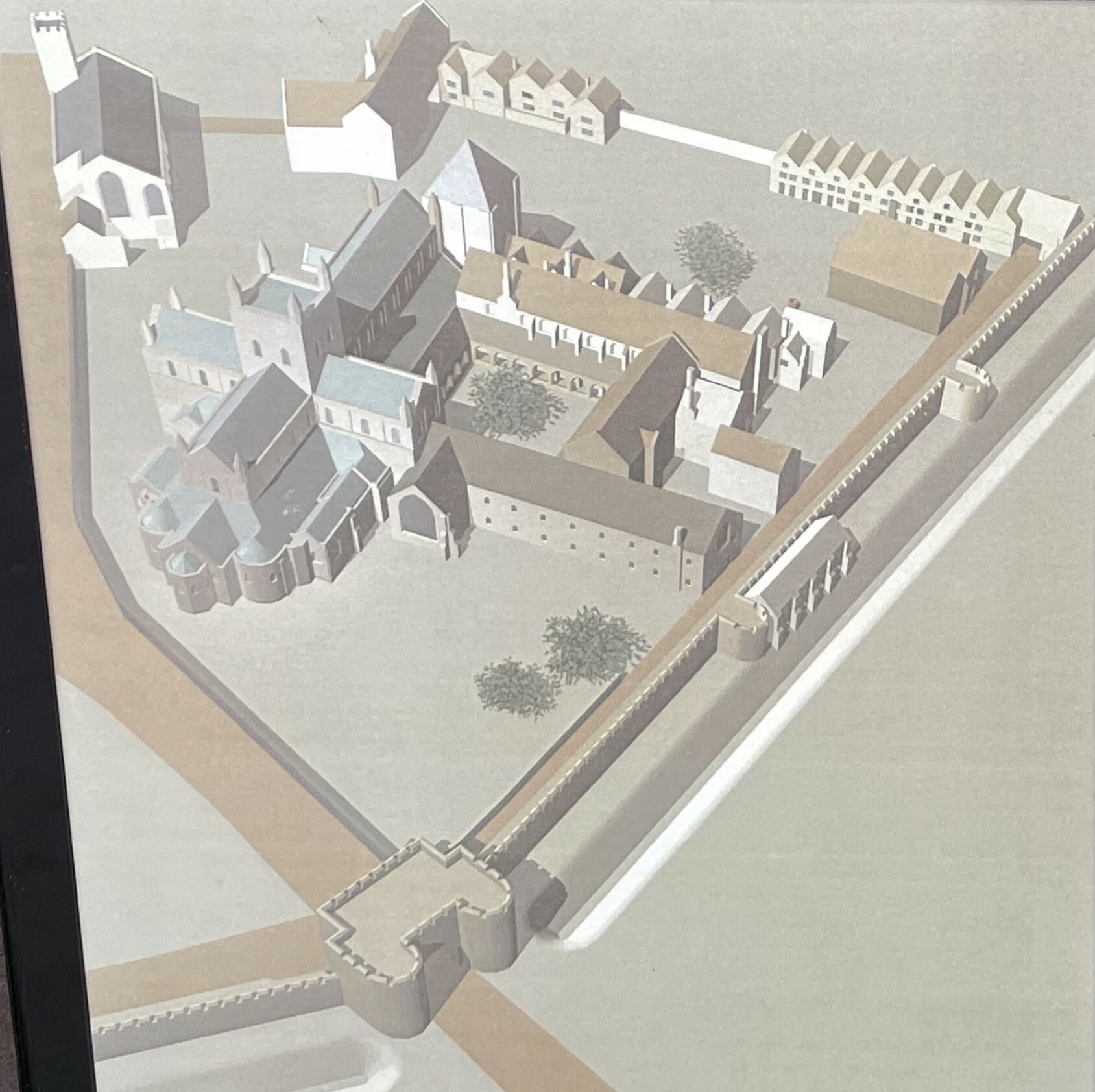
This very useful image is also taken from that information board (apologies that the photo is skewed) where it is captioned: "Richard Lea. Reconstructed three-dimensional view of Holy Trinity Priory at its fullest monastic extent circa 1500. © English Heritage/Historic England". This view is presented with north at the right. It shows that London Wall formed one boundary to the Priory (at the right) with the Aldgate at the bottom left.


Comments are provided by Facebook, please ensure you are signed in to see them