Records go back to 1348. From the Guild‘s website: "In its widest sense mercery could describe all merchandise, although in London the term evolved to mean the trade specifically in luxury fabrics, such as silk, linen, hemp-cloth and fustian, and in a large variety of miscellaneous 'piece goods' such as bedding, headwear, ribbons, laces and purses."
At Queen's Theatre you can see a Mercers' maiden. This is the symbol of the Mercers' Company and was used to mark their property. It can be seen on various buildings across London. gives more information.

This section lists the memorials where the subject on this page is commemorated:
Mercers' Company
Commemorated ati

Coburg Dwellings
Coburg Dwellings This block was built by the Mercers Company in 1904. It was ...

Mercers’ Maiden
Discovering London suggests that this might be the oldest inscription in London.
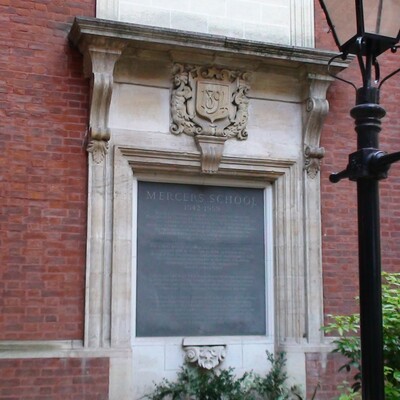
Mercers' School - in courtyard
Mercers’ school, 1542 – 1959 In 1542 the Mercers’ Company purchased the site ...

Widening Long Acre
Eight feet of ground from the stone of this house were given by the Mercers' ...
This section lists the memorials created by the subject on this page:
Mercers' Company
Creations i

Bridge of Aspiration
{Beneath the crest of the Royal Ballet School:} The Bridge of Aspiration, the...
Other Subjects

Hiram Shorey
Merchant tailor and co-founder of Rotary International. Born Hiram Elroy Shorey in Litchfield, Kennebec, Maine.
1 memorial

Ritz Hotel
Opened by Swiss hotelier Cesar Ritz. The first hotel in the country where every room had an ensuite bathroom.
1 memorial

1 memorial

John Thornton
Philanthropist who promoted Christian missionary work.  Died following an accident at Bath.  He is listed on the plaque as a menber of the Clapham Sect but it did not really get going until his dea...
1 memorial

Sir Frank Green
Businessman and politician. Born in Maidstone. He founded a company of paper merchants. Alderman on the Bridge House Estates Committee, 1894 and later, Chair. Elected as Lord Mayor of London in 1900.
2 memorials
Comments are provided by Facebook, please ensure you are signed in to see them